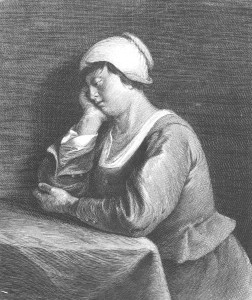
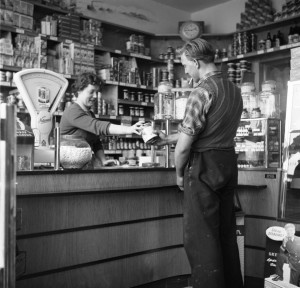
A particulier is a private person, someone not working for the government and not a business. For instance, when you buy something, it is important whether you buy it as a particulier (consumer) or as a business since your warranty may be different. In some records, the term was used to indicate a person who did not receive an income from current employment or running a business. This does not necessarily mean that the person was unemployed or poor, it could also be a person of independent … [Read more...]
Emergency baptisms by the midwife
28 August 2015 by 2 Comments
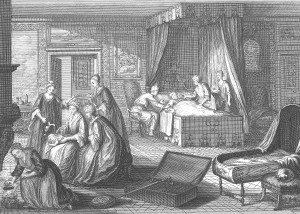
In the Roman Catholic church, if a child was in peril of dying during the delivery, the midwife was allowed to perform an emergency baptism. Here is a summary of the instructions for such baptisms, as printed in Brussels in 1698. Instructions for midwives regarding baptisms of young children who were born, or were in peril of not being born whole In case there is fear that the child will sicken or die, they shall wash the child with natural water while speaking these words: "I baptize thee … [Read more...]
Quick tip – Wiring money to the Netherlands
26 August 2015 by 1 Comment
If you're ordering records from municipalities or archives in the Netherlands, chances are that you will not be able to pay by credit card or PayPal. Most government agencies in the Netherlands are only set up to accept bank payments. To wire money, you will need the IBAN-number of the bank account that you're sending the money to, and the SWIFT-number of the bank. If you live in the European Union, wiring money is free, but if you live outside the EU, it could be expensive. A cheaper … [Read more...]
Dutch term – Schepel
24 August 2015 by Leave a Comment
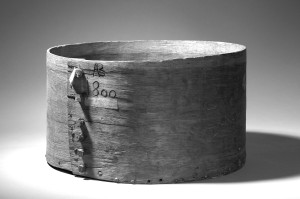
A schepel is a measure of surface as well as of capacity. One schepel of land used to be the amount of land you could sow with one schepel of grain. You may encounter the term in land records or tax records. The size of a schepel differed from one region to the next. For example, in Gelderland, a schepel of land was about 1450 m2, or 0.36 acres. In Twente, a schepel was about 887 m2 or 0.22 acres.1 Source "Schepel (oppervlaktemaat)," Wikipedia, … [Read more...]
Ask Yvette – A research plan for an 18th-century brick wall ancestor
21 August 2015 by 2 Comments
Reader Rob Ton wondered what other sources he might consult to identify the parents of his brick wall ancestor Aert Ton. Aert Ton was married in Heerewaarden, a village in Gelderland, on 19 May 1737 to Hendersken van Neerlangen. Neither his marriage nor his burial record identifies his parents. Since this is a common problem that many of you are facing, I thought I'd share how I create a research plan. I have never done any research in Heerewaarden before, so you can see how I discover what … [Read more...]
Quick tip – Turn the page!
19 August 2015 by Leave a Comment
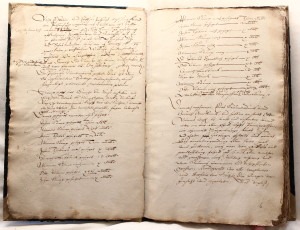
In Dutch records, often only the right page is numbered. So if you see a reference for your ancestor at page 15 and can't find her, turn the page and check the left side of page 16. Often, this reverse page is designated like fol. 15v, with a v for "verso" [Latin for reverse] and "fol." [folio] instead of p. [page]. But sometimes the numbers look like regular page numbers and don't give a clue that the record could be on the reverse page. One place where I've noticed this happening is in … [Read more...]
Dutch term – Dood
17 August 2015 by Leave a Comment
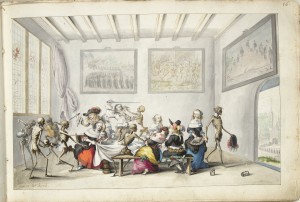
The word Dood means dead or deceased. Information about deaths can be found in death records (after 1811) or burial records (before 1811). In most cases, it will not be possible to find a cause of death. … [Read more...]
Where to find Dutch genealogy records online
14 August 2015 by 3 Comments
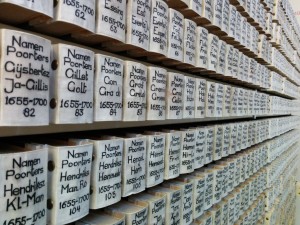
So you found out that your immigrant ancestor is Dutch. Perhaps you notice that the websites that you normally use don't have many Dutch records. Where do you go go next? Here are my favorite free websites to find records of our Dutch ancestors. All these websites provide free access to indexes, although some will charge to access or download scans. WieWasWie WieWasWie [Who Was Who] is the largest genealogy website of the Netherlands. It has indexed records and links to scans from many … [Read more...]
Quick tip – Not all religions baptized infants
12 August 2015 by Leave a Comment
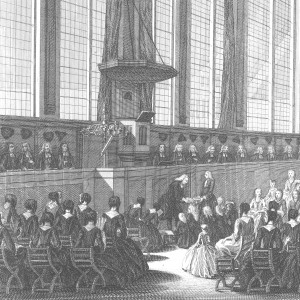
In the period before the civil registration, which was introduced in most of the Netherlands in 1811, baptismal records are the usual documents to consult for information about the birth date of an ancestor. In most cases, children were baptized within days of being born. But some religions did not baptize infants but waited until people were old enough to make an informed decision about joining the church. In the Netherlands, the main church that baptized adults was the Anabaptist or … [Read more...]
Dutch term – Archiefstuk
10 August 2015 by Leave a Comment
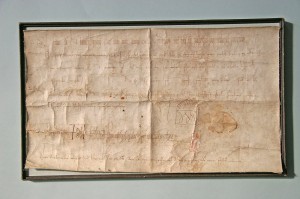
An Archiefstuk is an archival record, a document created or received in the course of a person or organization's activities or tasks. The oldest surviving archiefstuk in the Netherlands is a 950 charter whereby King Otto I granted the right of a market and toll to Cassalum (unidentified location). The charter is kept by the Regionaal Historisch Centrum Limburg. … [Read more...]