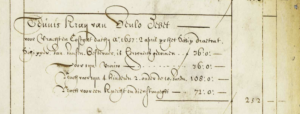
If you are lucky, an English translation exists for Dutch records. For example, many New Netherland records have been translated. In some cases though, what is presented as translations are actually abstracts. The original may have more information. Another aspect to consider is that translations are interpretations, and may have mistakes. For example, an account book of the West India Company 1650-1664 that includes money paid for passage to New Netherland is often presented in … [Read more...]
Quick tip – Wills in the third person
1 December 2021 by Leave a Comment
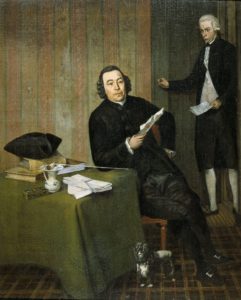
Some people are surprised that many Dutch wills are in the third person ("leaves HER house to HER brother and HER sister"). This is because the wills are drawn up by a notary or court clerk, and the "I" in the record is the notary. "Today appeared before me, notary so-and-so, Mrs. this-and-that who declared this to be HER last will." … [Read more...]
Quick tip – Jump the pond
17 November 2021 by 1 Comment
If you are trying the find the origins of an immigrant ancestor, don't be afraid to jump the pond and start research in the place of origin if you get stuck. Researching the person in the place you know they lived (after immigration) is a good strategy to start your research into an immigrant ancestor. That may give you clues about their place of origin, their relatives, and their social network. But sometimes, even the most detailed research in a place of destination does not reveal … [Read more...]
Quick tip – Dutch Dates are day-month-year
3 November 2021 by Leave a Comment
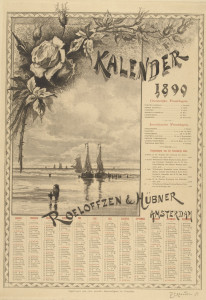
In the Netherlands, and many other countries, dates are written day-month-year. So 3-11-2021 is 3 November 2021, not March 11. Many original records spell out the month to avoid confusion, but you may encounter dates with numbers for the month in genealogical publications. … [Read more...]
Quick tip – Your ancestor was not born in Elders
27 October 2021 by Leave a Comment
In some online trees, you will see "Elders" as the place of birth. This is typically the result of a person who does not speak Dutch finding the reference in a Dutch record. However, "Elders" is not a placename, it means "elsewhere." … [Read more...]
Quick tip – Intermediate course on Dutch handwriting
13 October 2021 by Leave a Comment
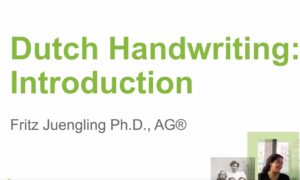
FamilySearch has created an intermediate course for learning how to read Dutch handwriting. In the course, Fritz Juengling discusses strategies and tools for learning how to read Dutch records. The free online course consists of sixteen videos. … [Read more...]
The three most relevant archives
8 October 2021 by Leave a Comment
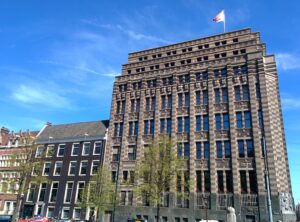
When you are researching, there are archives/repositories at three different levels that may hold relevant records for you. They correspond with the three levels of government: municipality, province, and country. Local or regional archives Each municipality turns over their records to a local or regional archive. Examples of local archives are the Amsterdam City Archives or the Oldenzaal city archives. These municipalities have their own archivist rather than using the services of a regional … [Read more...]
Quick tip – The suffix ‘-je’
22 September 2021 by Leave a Comment
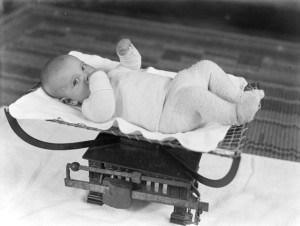
In the Dutch language, the suffix '-je' indicates a diminutive. Depending on the preceding word, it can be -je, -kje, -tje, -pje, or -etje; sometimes with an -n at the end. In Low Saxon dialects in the north-east of the Netherlands, -ke, -ske, -ken, -sken, or -chien are used. The diminutive suffix is used for nouns and names. Many female names are diminutive forms of male names. The diminutive form of a name is also used for a young child, so studying the name in context is necessary to … [Read more...]
Quick tip – Mind the long S
8 September 2021 by Leave a Comment
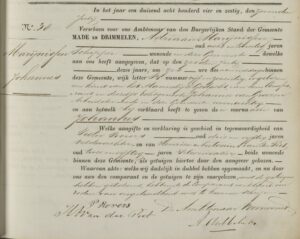
Up until well into the twentieth century, there were two different ways to write the letter 's' in Dutch (and other languages): the regular 's' and the long 's'. The long 's' looks like an 'f' without the crossbar. The long 's' is used in different situations. In words with double 's,' the second 's' is often written in the long form. When transcribing names or words with a long 's', make sure to transcribe it correctly as an 's.' For example, the name of my ancestor in the birth record … [Read more...]
Quick tip – Video about using WieWasWie
25 August 2021 by 1 Comment
FamilySearch features a helpful video where Fritz Juengling explains how to use the website WieWasWie (Who Was Who) for researching your ancestors in the Netherlands. Go to the video … [Read more...]