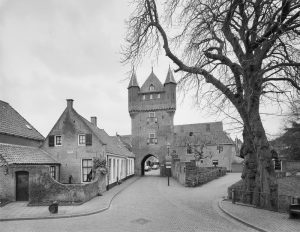
The stadspoort is the city gate. Until modern times, most cities had a wall around it, with gates protecting the entrance ways. Most towns had a portier or gatekeeper that was responsible for opening and closing the gates each day. … [Read more...]
Dutch term – Bruiloft
6 March 2017 by 4 Comments
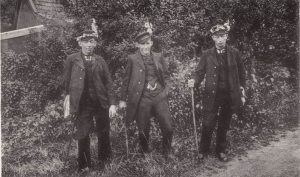
A bruiloft is a wedding. Different regions have different wedding traditions, and they also changed over time. The area of Twente in Overijssel, where I grew up, has some peculiar wedding traditions. Other regions have similar or slightly different traditions, but I thought I would share some that I experienced myself. Even in my generation (born in the 1970s), I knew a few girls who would start their trouseau as a teenager. They started asking for plates and linens from their twelfth … [Read more...]
Dutch term – Pieremagoggel
27 February 2017 by 2 Comments
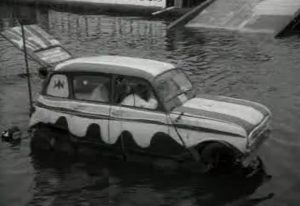
A pieremagoggel is a vessel, but not a boat since it cannot have a keel. The term is sometimes used to denote a ship that was no longer considered sea-worthy. Other pieremagoggels are built for fun, rather than any practical applications. Pieremagoggel contests score the vessels based on their creativity, and ingenuity of the propulsion mechanism, humor, and esthetics; with winners in different categories. It is not surprising that students of polytechnic schools often enter … [Read more...]
Dutch term – Dijkwerker
22 February 2017 by Leave a Comment
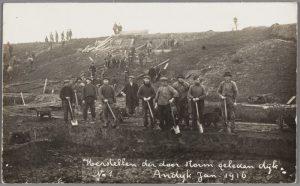
A dijkwerker is a dike worker, somebody who creates and maintains dikes. In earlier times, people in a community that was protected by a dike would be required to help maintain the dike. Later, this was changed to a tax that paid professional dike workers to maintain the dikes. Taxes still pay for the upkeep of the dikes today. … [Read more...]
Dutch term – Geregistreerd Partnerschap
13 February 2017 by Leave a Comment
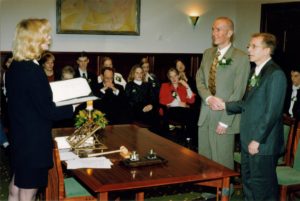
"Geregistreerd partnerschap" or registered partnership is a form of a civil union. It was introduced in the Netherlands in 1998 to allow same-sex couples to enjoy some of the same rights as married partners. The partnership is not limited to same-sex couples though: Male and female partners can also join in a registered partnership. The Geregistreerd Partnerschap can be seen as the predecessor of the same-sex marriage, which became legal in the Netherlands in 2001; the first country in the … [Read more...]
Dutch term – Veldwachter
6 February 2017 by 1 Comment
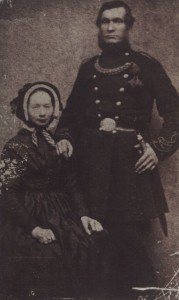
A veldwachter was a police constable. In 1858, a national police force was established in addition to the municipal constabulary. From that period onwards, you will find a difference between a gemeenteveldwachter (municipal constable) and rijksveldwachter (national constable). Appointments of national constables can be found in the Staatscourant, which is available online at Delpher, or in the Algemeen Politieblad, which is available at the website of the Centraal Bureau voor Genealogie … [Read more...]
Dutch term – Rechtszitting
30 January 2017 by Leave a Comment
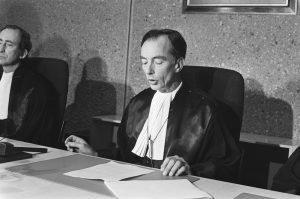
A rechtszitting is a court session. The protocols of the sessions can have detailed information about the charges, defense, and witness statements. Court records can often be found in regional archives. Some archives have put indexes online. Check the Digital Resources Netherlands and Belgium website to find out which sources are online for the region you're looking for. … [Read more...]
Source – Notarial records
27 January 2017 by Leave a Comment

Notarial records are created by a public notary and serve as legal proof of the information contained in the record. Information in notarial records Examples of the types of records you can find in notarial archives are: Real estate transactions (sales, conveyance) Debts Obligations Auctions Prenuptial agreements Last wills Estate divisions Work contracts Replacement contracts for enlisted men Powers of attorney A notary created copies of most of the records … [Read more...]
Dutch term – Probant
23 January 2017 by 1 Comment
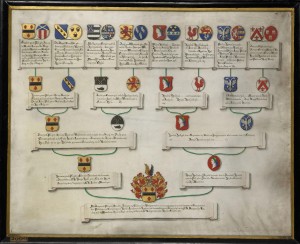
The probant or proband is the home person in a chart or narrative of the ancestors of the person. In the Sosa-Stradonitz numbering system, the proband has number 1, his father number 2, mother number 3, et cetera. … [Read more...]
Dutch term – IJzen
16 January 2017 by 2 Comments
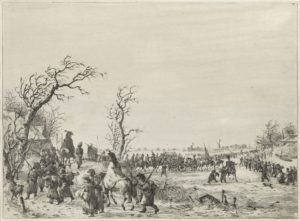
IJzen means to break the ice. During wartime, the ice in the moats around fortified towns had to be broken up, to prevent hostile forces from walking over the moat to take the town. Sometimes, ijzen was the obligation of the citizens of the town, or of specific farmers in the area who rented the farm from the overlord. In other towns, the garrison was responsible for making sure the moat did not freeze shut. … [Read more...]