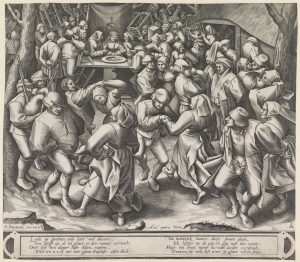
In the Netherlands, you have to go in "ondertrouw" before you get married. This means that the banns are read, giving everyone in the community a chance to object to the marriage. In the period before the introduction of the civil registration, church records are the most important source of vital information. Many churches recorded the banns rather than the marriage. They recorded when the couple registered the banns, and sometimes noted the marriage announcements on three different times, … [Read more...]
Dutch term – Markt
9 January 2017 by Leave a Comment
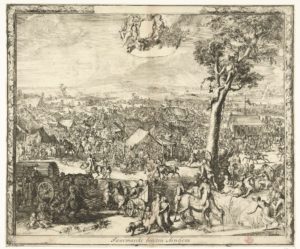
A markt is a market. During the Middle Ages, the right to hold markets was a seignorial right, granted by the overlord. The right to have a market was often the first step to becoming a chartered town. Today, many towns have a weekly market on a fixed day of the week. Sometimes, a market has been held on that same day in that town for more than four hundred years. In addition to the weekly markets, many towns also had a jaarmarkt, an annual market. That would be a major affair, where … [Read more...]
Dutch term – Tweede Kerstdag
26 December 2016 by Leave a Comment
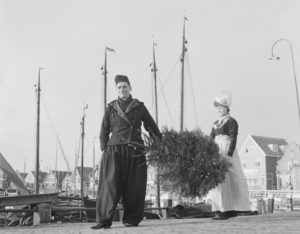
Tweede Kerstdag is the Second Christmas Day, like Boxing Day in the UK. It is an official holiday in the Netherlands. The Second Christmas Day was introduced to facilitate going to church multiple times, and to have some time off for contemplation and relaxation. Nowadays, the Second Christmas Day is often used to visit in-laws, go to a concert, or do some shopping in furniture malls. Prettige Kerstdagen! (Happy Christmas Days) … [Read more...]
Dutch term – Stal
19 December 2016 by Leave a Comment
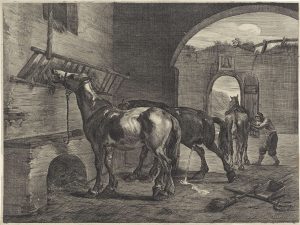
A stal is a stable. A stalhouder is a stable keeper. Originally this would have been a cattle farmer, but the meaning later changed to somebody who rents out horses and carriages. … [Read more...]
Dutch term – Handelaar
12 December 2016 by 1 Comment
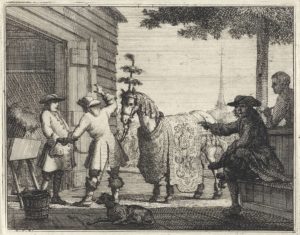
A handelaar was a trader. Handelaren could mostly be found in cities, not villages, and were often quite well-to-do. Sometimes, specific words were used to show what people were trading in: a graanhandelaar traded in grain, a fietsenhandelaar traded in bicycles, and a handelaar in koloniale waren traded in colonial goods. You can also use newspapers, court records, or tax records to find out what your ancestor was trading in. Another word for handelaar is koopman (merchant), where … [Read more...]
Dutch term – Pakjesavond
5 December 2016 by Leave a Comment
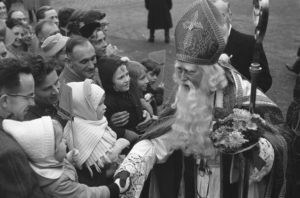
Pakjesavond = "gift evening." Traditionally, Dutch families give gifts on St. Nicholas' Eve, on December 5th. Sinterklaas and his helpers, the Zwarte Pieten, will bring gifts for all the children and some of the adults too. "Santa Claus" is derived from the Dutch word "Sinterklaas." Read more about the differences and similarities about these red-robed men in the Sinterklaas article. … [Read more...]
Dutch term – Buurtschap
28 November 2016 by Leave a Comment
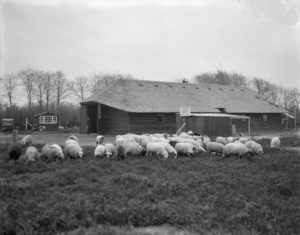
A buurtschap is literally a neighborship. It is a part of a municipality or parish. Unlike a village or town, a buurtschap usually does not have a center or church but consists of a group of farms dotting the landscape. Buurtschap is a word most commonly used in rural parts of the Netherlands. The closest English term would be hamlet. In many places, the buurtschap had an economical and a social function. Often, taxes were collected at the buurtschap level, and each buurtschap would … [Read more...]
Dutch term – Dijkgraaf
21 November 2016 by 1 Comment
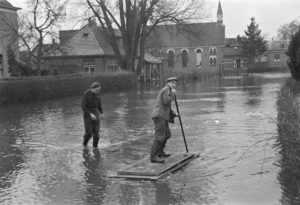
A dijkgraaf is a dike reeve, the head of a waterschap [water board]. He is responsible for the water management, including flood control, in his district. His function is similar to a mayor of a municipality. Nowadays, a dijkgraaf is appointed by the King for a period of six years. Historically, a dijkgraaf was usually somebody who had extensive property in the district for which he managed the water, to ensure he would do his best to keep the land dry. If your … [Read more...]
Dutch term – Walvisvaart
14 November 2016 by Leave a Comment
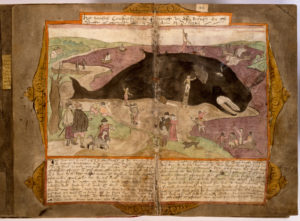
Walvisvaart is whaling. Dutch commercial whaling started in the 1600s. Many skippers from the province of Holland went north to the waters around Scandinavia and north of Russia to catch giant whales. The village of De Rijp had a thriving whaling industry and at one time had a fleet of ten whaling ships. The whale fat was turned into codfish oil, used for a wide range of purposes including lamp oil or as ingredient for soaps and paints. Whale bones were used to make glue or as building … [Read more...]
Dutch term – Verkiezing
7 November 2016 by Leave a Comment
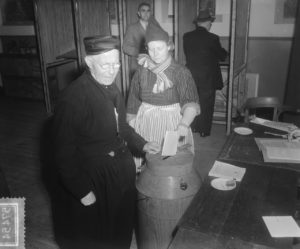
Verkiezing means election. In the Netherlands, it took until 1917 for all men to get the vote. Before that time, only men with sufficient means were allowed to cast a vote. Women followed two years later and got the vote in 1919. In the Netherlands, citizens can vote for three levels of government: National (Tweede Kamer, house of representatives) Provincial (Provinciale Staten, provincial representatives) Municipal (Gemeenteraad, the town council) Water board … [Read more...]