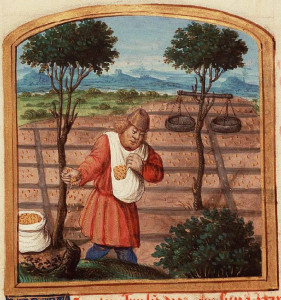
In old records, you may find the word 7ber or 7bris for the month. This means "september" [Dutch] or Septembris [Latin]. The names of the months were established when the start of the year was in March and September was the seventh month. Do not confuse 7ber for July, the seventh month of our current calendar. … [Read more...]
Source: Estate Inventories
1 September 2023 by Leave a Comment
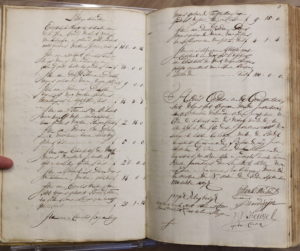
Estate inventories tally the assets and debts of a person, family, or company. They were typically created for people of means. You are unlikely to find them for poor ancestors. Different regions have different customs, but in general, you are unlikely to find them before the 1600s, though you may find earlier examples. The most important reasons for creating an estate inventory are: ensuring the rights of minor heirs after a parent died. documenting what a spouse brought to a … [Read more...]
Dutch term – Perkament
28 August 2023 by Leave a Comment
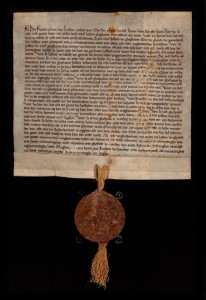
Perkament is parchment. In the Middle Ages, parchment was the main surface for writing. It was created from animal skin, such as sheep or calf skin. Many medieval chronicles and charters were written on parchment. Gradually, parchment was replaced by paper for most types of writing, first created from textile and later created from wood. Charters kept being written on parchment, but were becoming less common. Nowadays, parchment and charters are rarely used, unless for ceremonial purposes. … [Read more...]
Dutch term – Rapport
21 August 2023 by Leave a Comment
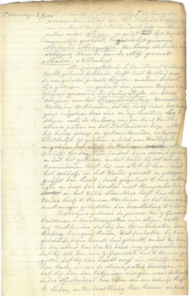
A rapport is a report. You may come across rapporten in archival descriptions, for example of archives of authorities. Police archives may include dagrapporten (daily reports). For an example of a police report, see the article about how Adriaan Marijnissen died. … [Read more...]
Dutch term – Auteur
14 August 2023 by Leave a Comment
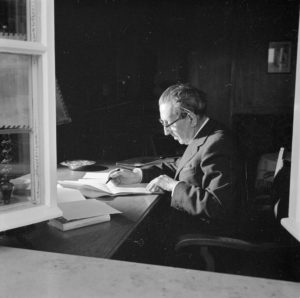
An auteur is an author. Before the introduction of modern copyright laws, publishers could sometimes obtain a patent, giving them exclusive rights to publish a book. You may find these patents in court records. The first real copyright law in the Netherlands dates from 1817. The current copyright law is the Auteurswet 1912. A work is protected by copyright for 70 years after the death of an author (counted from January 1st in the year after the death). Work that was published anonymously … [Read more...]
Dutch term – Bakoven
7 August 2023 by Leave a Comment
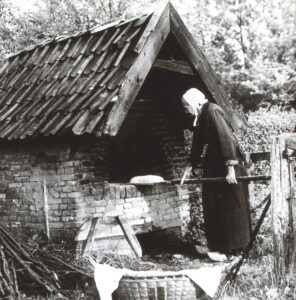
A bakoven is a baking oven. People sometimes had a baking oven as a separate building, to prevent fire in the house. They are most commonly found in rural areas. You may come across the term in property records, such as notarial or court records. … [Read more...]
Dutch term – Strafzaak
31 July 2023 by Leave a Comment
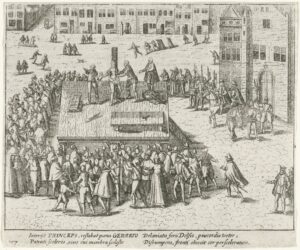
Strafzaak means "criminal case." You may see the plural, strafzaken, in the archival descriptions of court records. The finding aids often have separate series for criminal records. These may include the case files or verdicts. The severity of the crime determined where the case was tried. For each place where my ancestors lived, I try to find out which court had lower jurisdiction and which had higher jurisdiction. Major crimes, like murder, arson, or grand larceny, would be tried by … [Read more...]
Dutch term – Gardenier
24 July 2023 by 2 Comments
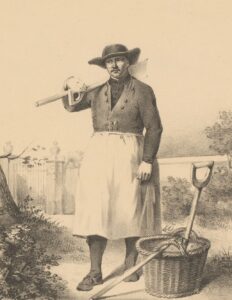
The word gardenier can have different meanings, depending on the location: In Friesland, it typically meant a small farmer, usually someone who grew crops like potatoes or other vegetables. In other places it typically meant gardener. Another Dutch word for gardener is tuinman. If you are unsure which is meant, check other records. If several neighbors were also gardeniers, chances are they were farmers. The same goes if the ancestor owned farm land, which you can find in cadastral, … [Read more...]
Dutch term – Jachtrecht
17 July 2023 by Leave a Comment
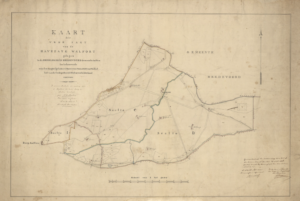
Jachtrecht means the right to hunt. Until 1923, the right to hunt was a noble right. In many areas, the landlord was entitled to hunt across other people's lands. Well into the nineteenth century, you can see hunting rights being auctioned off to the highest bidder. Today, hunting is strictly regulated and mostly done as part of estate management. Hunters need a license that has several requirements, including permission from the owner of the land. … [Read more...]
Dutch term – Duim, voet, roede
10 July 2023 by Leave a Comment
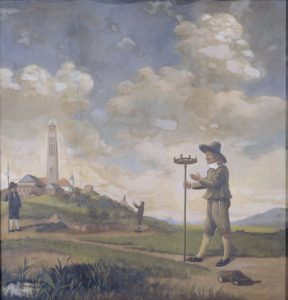
These are three measures of length that were in use until the implementation of the metric system during the French occupation (1795-1813). Duim (thumb): about 2.5 cm/1" Voet (foot): about 30 cm, about 11.8" Roede (rod): around 3.6-4 meters (11'10"-13'1.5"). The exact size depended on the time and place. In general there were 12 duimen in a voet and 12 voeten in a roede, but a roede could have as many as 20 voeten. … [Read more...]