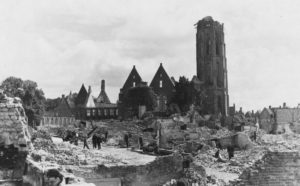
On Facebook, Linda Roos asked me about the differences between genealogy in the Netherlands and the United States. That topic warrants a longer reply than I gave her on Facebook, so here we go! 1: Quality of sources In the Netherlands, we have an abundance of high-quality sources. Since 1850, we have had the population register, recording who lived where: not just every ten years but kept up-to-date. Civil registration records of births, marriages, and deaths go back to 1811 or even earlier. … [Read more...]
Quick tip – Who Else had that Rare Name?
1 June 2016 by Leave a Comment
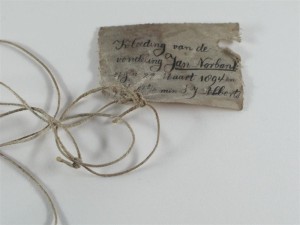
As you probably know, Dutch children were usually named after family members. If one of your brick wall ancestors had an unusual name, or gave one of their children an unusual name, it might be worthwhile to look who else in the community shared that name. You can then investigate that person's family to see if your brick wall ancestors fits in somehow. The other person could well be a grandparent, aunt, uncle, godparent, but could also be the landlord. They may have left records of their own … [Read more...]
Dutch term – Regest
30 May 2016 by Leave a Comment
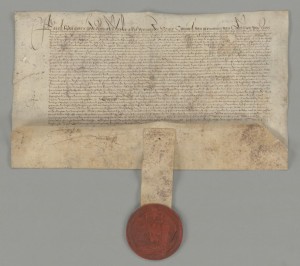
A regest is an abstract of a record, usually of a medieval charter. Many archives provide regesten of their oldest records, which are often in Latin and in a handwriting that is hard to read to modern eyes. You can find regesten at the websites of archives, or in published oorkondenboeken (charter books). See the article about Oorkonde (charter) for links to these online charter books. … [Read more...]
The Bosch’ Protocol Crowdsourcing Project
27 May 2016 by 1 Comment
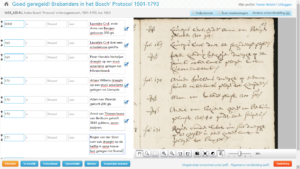
442 years of records, spanning the period of 1367 to 1809. One of the most complete series of court records anywhere in the country. More than half of them in Latin. The Bosch' Protocols, the voluntary court records of the jurisdiction of 's-Hertogenbosch in Brabant, are a treasure trove of information. It has wills. It has deeds. It has prenups. It has stories about families from the entire region, since the jurisdiction of the city encompassed a large part of the former province of … [Read more...]
Quick tip – Don’t confuse the date of the record and the event
25 May 2016 by Leave a Comment
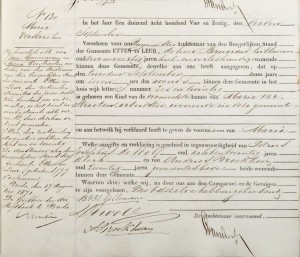
Births and deaths are created within several days of the event. The first date that you will find in the birth record or death record is the record date. Further down in the record, you will find the actual birth or death date, which could have been up to five days earlier. Indexes sometimes only have the record date, so make sure to always check the original record. Marriages were recorded on the day of the marriage, so there is no difference between the date of the event and the record … [Read more...]
Yvette Hoitink, Certified Genealogist
23 May 2016 by 17 Comments

I have just received news from the Board for Certification of Genealogists that my application for the Certified Genealogist® credential has been successful. In the Netherlands, genealogy standards are mostly unknown. The solution to most genealogical problems is to search until we find direct evidence, which we generally have in abundance. It is rare to see a proof argument, even in reputable journals. This does not mean that the research is of poor quality, just that the methods and … [Read more...]
Dutch term – Family Relationships
23 May 2016 by 5 Comments
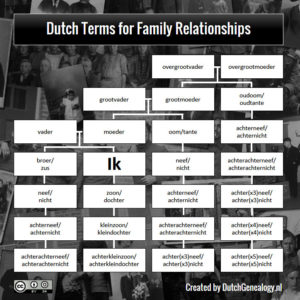
This diagram shows you the Dutch terms for the most common family relationships. In practice, we don't use the more distant relationships than achterneef/achternicht; we just call them "verre neef" or "verre nicht" [distant cousin]. … [Read more...]
Ask Yvette: Untangling two same-named women
20 May 2016 by 1 Comment
My distant cousin, Fred Geurkink, asked me the following question [edited for brevity]: My grandma Gigi, (Marion Peterson), wrote down in her recollections about my great great grandma Grietje Koning. Said she was born on 30 Aug 1834, married my gg grandpa Jan Pieters Stelma on 23 Jun 1856, etc etc. On Ancestry, I received "hints" about said Grietje Koning from other members, who also married Jan Pieters Stelma, but her birthday was different: July 29 1834. Could my grandma be wrong, or are … [Read more...]
Quick tip – New URL for Database of Surnames in the Netherlands
18 May 2016 by 1 Comment
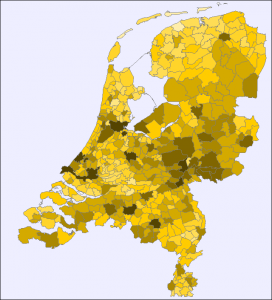
The database of surnames in the Netherlands has a new home. It is now maintained by the Central Bureau for Genealogy and available at cbgfamilienamen.nl. In the database, you can look up a name to see how popular it was in 1947 and 2007, and where those people lived. In many cases, there will be a description of the origin of the name and literature references to publications about the name. Visit the Database of Surnames in the Netherlands … [Read more...]
Dutch term – Visser
16 May 2016 by Leave a Comment
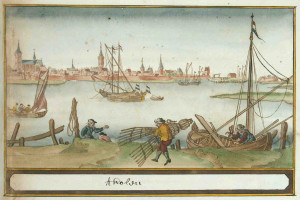
A visser is a fisherman. Fishing was a common occupation in the coastal towns of the Netherlands, including those surrounding the Zuiderzee (now: IJsselmeer). Willem Beukels, a fisherman from Biervliet in Zeeland, invented the technique of gibbing herring, which allowed Dutch fishermen to remain at sea for longer periods of time before the fish would go bad. The secret of gibbing gave the Dutch a commercial advantage. Du tch herring is still renowned. … [Read more...]