To celebrate the 500th webinar, Legacy Family Tree Webinars has a free access weekend from Friday 14 until Sunday 16 April 2017. The free webinars include Yvette Hoitink's Researching your Dutch Ancestors, which she presented in September 2015. Did you miss the free weekend? You can sign up for a membership. For $49.95, you can watch any of the 500 webinars and all the new ones for a whole year. Or if you like binge watching, you can get a one month subscription for just $9.95. … [Read more...]
How to find out if your ancestor served in the Dutch army
14 April 2017 by 8 Comments
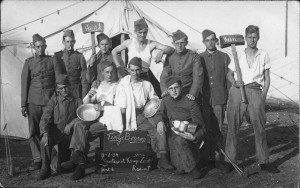
Finding soldiers after 1811 If your male ancestor married between 1811 and 1932, the marriage supplements should have a declaration that he fulfilled his military duties. This declaration should show if the ancestor served or got an exemption. If you are lucky, the declaration will name the regiment. Another way to find out if your ancestor served is by consulting the militieregisters [militia registers], which recorded all men that were called up in a municipality in a given year. Some of … [Read more...]
Dutch term – Van Halven Bedde
10 April 2017 by 2 Comments
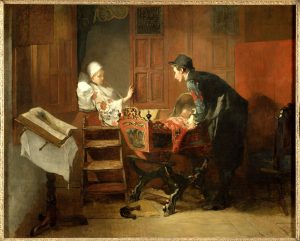
Van halven bedde literally means "from half a bed." It is a term indicating half-siblings or half-aunts and -uncles. For example, if somebody refers to a woman as her "zuster van halven bedde" [sister from half a bed] this refers to a half-sister and a "oom van halven bedde" [uncle from half a bed] refers to a half-uncle. … [Read more...]
Dutch Genealogy News for March 2017
7 April 2017 by 1 Comment
What's new in online Dutch genealogy this past month? New online records 700,000 marriage records from before 1811 from Gelderland were added to WieWasWie. Scans of marriage supplements of the Frisian municipalities of Achtkarspelen, Aengwirden, Ameland, Baarderadeel, Barradeel, and Bolsward have become available at AlleFriezen. Other municipalities to follow. Scans of notarial records of Alkmaar 1550-1842 have been added to FamilySearch. The notarial records of Limburg 1842-1895 … [Read more...]
Dutch term – Kruidenier
3 April 2017 by 1 Comment
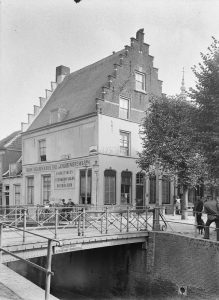
A kruidenier is a grocery (the shop) or grocer (the occupation). The word kruiden means spices, and reminds of the colonial origins of the word, when people would go to the kruidenier to buy pepper and nutmeg from the East Indies. Since the 1960s, most kruideniers have been replaced by supermarkets. … [Read more...]
Quick tip – Mind the Chronology of a Population Register
29 March 2017 by Leave a Comment
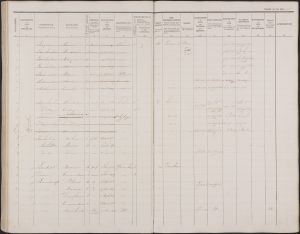
When using population registers, pay attention to the different dates. A page in a population register shows who lived in a house during a period, usually ten years or so. Just because the people are listed in the same household, does not mean they actually lived in that house at the same time. Population registers have columns for birth, marriage, death, arrival, and departure. It can help to plot all these dates on a time line to see who was living in the house when. For example, you … [Read more...]
Dutch term – Vrouw
27 March 2017 by Leave a Comment
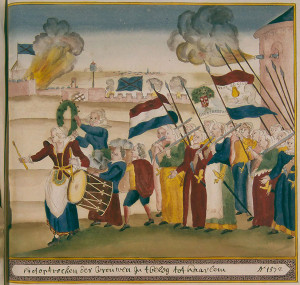
The word vrouw (plural: vrouwen) means woman. It can also mean wife. … [Read more...]
Quick tip – Inventories are Usually for Both Spouses
22 March 2017 by 1 Comment
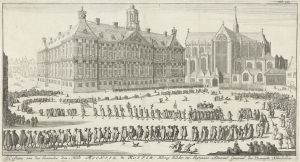
If you find an estate inventory of a deceased married person, beware that the property in the inventory is usually for the couple, not just the property that belonged to the deceased spouse. If there was no prenuptial agreement, the husband and wife jointly owned all their property. The inventory would usually appraise all the property, of which the deceased's share would be half. That half would be divided among the heirs of the deceased, such as his or her children or (in the absence … [Read more...]
Dutch term – Overstroming
20 March 2017 by Leave a Comment
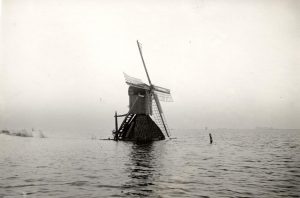
An overstroming is a flood or inundation. A large part of the Netherlands is below sea level, protected by dikes. If dikes aren't high enough or get oversaturated, the land protected by the dikes can flood. The last big flood was in 1953, when 1836 people died when large parts of Zeeland and Noord-Brabant flooded. … [Read more...]
Column – Fake News and Alternative Facts
17 March 2017 by Leave a Comment

You see it everywhere online: fake news. Sensational stories, written to draw attention and gain clicks for ads. Fake news about the presidential candidates may even have influenced the US elections. Even in genealogy, it is often the less reliable information that draws our attention. Complete family trees can be found online, but may not be based on solid research. Indexes are easier to access than original records, but may have mistakes. And because of copyright restrictions, genealogy … [Read more...]