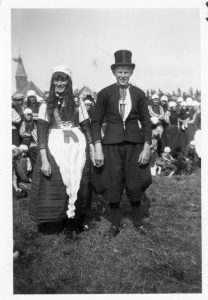
A moetje is a situation where a couple married because the bride was pregnant; a shot-gun wedding in modern terms. "Moeten" is the verb "must" and "-je" is the diminutive form. So the marriage was a "bit of a must." Customs were different in different areas and among different social classes. Among laborers in Friesland, it was quite common to hold off marriage until the girl was pregnant. But among farmers in Gelderland, most children were born at least nine months after the wedding. By … [Read more...]
Quick tip – Netherlands featured at Western European Family History Conference
12 May 2017 by 2 Comments

Next week, the Family History Library presents a week-long free conference about Western European Research. Each day focuses on a different country: Monday 15 May: Germany Tuesday 16 May: France Wednesday 17 May: The Low Countries Thursday 18 May: The Netherlands Friday 19 May: Switzerland. You can either attend in person in Salt Lake City or virtually by attending the webinar. Some of these lectures are especially interesting for those of us researching Dutch … [Read more...]
Dutch Genealogy News for April 2017
12 May 2017 by Leave a Comment
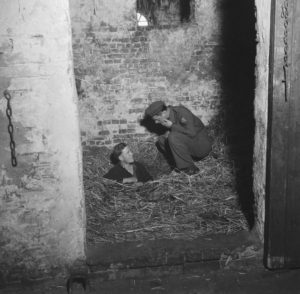
Here are some of the new websites and resources that have become available to us in the past month. Online Dutch records In Friesland, five thousand cards that recorded the hiding places of people in World War II were discovered. These include Jewish people and people who were involved in the resistance. The cards have been scanned and indexed and can be searched at the Onderduiken in Friesland [In Hiding in Friesland] website. The Redbot Digitization Project also scanned many other … [Read more...]
Dutch term – Grootburger and Kleinburger
8 May 2017 by Leave a Comment

A burger is a burgher, a resident of the town with certain rights. Some towns had different levels of burghership, the grootburger [large burgher] and the kleinburger [small burgher]. The rights associated with each status depend on the location and period. Example: Burghers in Deventer This example is a translated abstract from information provided by the Historisch Centrum Overijssel, location Deventer. The city of Deventer in Overijssel recognized residents and burghers. Residents … [Read more...]
Five Resources for World War II Research
5 May 2017 by 2 Comments
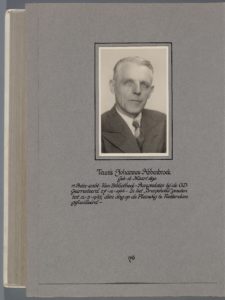
It can be hard to find out what happened to your family in World War II, since it was often not talked about. Here are some resources that may help you. Newspapers (Delpher) The newspaper website Delpher has many digitized newspapers from World War II and afterward. Some things to look for: Names of your ancestors during the war Names of your ancestors after the war, for example to see if they were tried for collaboration. Articles about what was going on in the town where they … [Read more...]
Dutch term – Arbeider
1 May 2017 by Leave a Comment
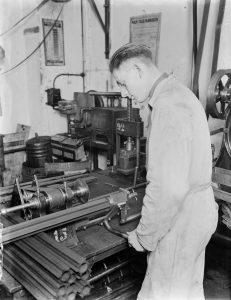
An arbeider is a laborer. Sometimes, records will indicate the type of work they did, such as a boerenarbeider [farm laborer] or fabrieksarbeider [factory worker]. Most laborers were poor and did not own any real estate. Many were illiterate. … [Read more...]
Researching Relatives with Disabilities
28 April 2017 by 9 Comments

A forty-four-year-old man lies buried in Winterswijk, the Netherlands. His grave has an ordinary marker, but with an unusual design: it has a toy on it. People who walk past it wonder why a grown man would have a toy depicted on his grave. They don't know that the man who rests there was my uncle, Dinant, who had severe mental disabilities. During his birth, Dinant was deprived of oxygen. He suffered severe brain damage, resulting in mental disabilities. His condition got worse as he got … [Read more...]
Dutch term – Tuugkist
24 April 2017 by Leave a Comment
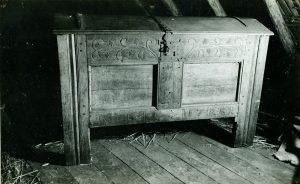
A tuugkist is a chest that is used to store personal belongings such as clothes or jewelry. It is a word that is used in the eastern provinces of the Netherlands. Many tuugkisten have elaborate carvings. Some of them even have the initials or a date. Tuugkisten were often made when a couple started their own household,, so it can even provide evidence about the time a marriage took place. … [Read more...]
Quick tip – Create a Property List
20 April 2017 by Leave a Comment
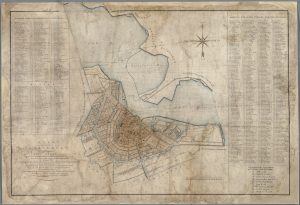
When you're researching a family who owned property, try making a list to see how they acquired it and where it went. Properties for which you can't find a purchase record may have been inherited from an older generation. Tracing the ownership of the property can help you identify other family members. This technique is one of the ways I was able to build a case to prove the parents of Griete Smit, as I wrote about in the National Genealogical Society Quarterly in December 2016. … [Read more...]
Dutch term – Mulat, Mesties, Casties, Poesties, Testies
17 April 2017 by 3 Comments
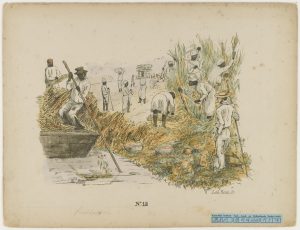
The Netherlands was involved in the slave trade from the late 1500s to the early 1800s. In the Dutch provinces, chattel slavery was outlawed, but it was common in the Dutch colonies such as Curacao and Suriname. In the colonies, slavery was abolished in 1863. In these Dutch colonies, specific terms were used to indicate the race of enslaved and freed people of color. These terms are offensive to our modern ears but understanding the meaning of these terms can be a vital clue to understanding … [Read more...]