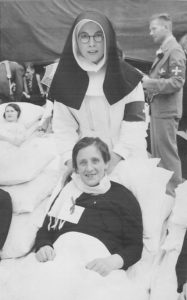
If you are researching an ancestor who was born in the 1800s, you might assume that all their records are public because they were born more than 100 years ago. But that may not be the case. If your ancestor married after 1942, their marriage record is not public yet. Similarly, court records, notarial records, prison records, and many other records have a 75-year limit before they become public. If your ancestor died after 1967, their death record is not public yet. An example is my … [Read more...]
Quick tip – Don’t Confuse Cousins, Nieces, and Nephews
30 April 2018 by 6 Comments
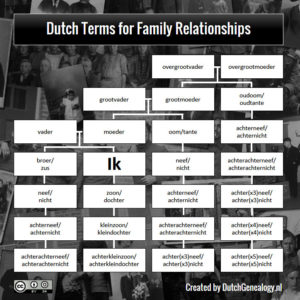
In Dutch, the word neef can mean either nephew or male cousin, while the word nicht can mean either niece or female cousin. Automatic translators sometimes translate the terms with nephew and niece only, which can lead you to the wrong conclusion about family relationships. … [Read more...]
Quick tip – Researching Living People Needs Their Collaboration
18 April 2018 by Leave a Comment
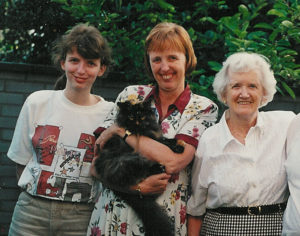
Dutch privacy laws are strict and restrict access to records of people born less than 100 years ago. If you are searching for living people, they will be the only ones who can access their records. Their cooperation and permission is also necessary if you want them to take a DNA test for you. See the article on proving my descent from my mother for an example. … [Read more...]
Quick Tip – Is that Dutch Name Male or Female?
28 March 2018 by 22 Comments
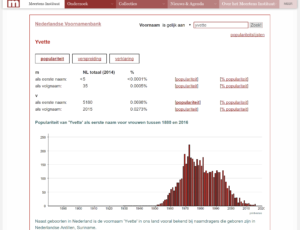
If you're not Dutch, you may wonder if a first name is male or female. You can consult the First Name Database to search for the name. It will give you statistics on how many men ("m") and women ("v") had that name in the past 100 years. You can see a graph that shows the popularity of the name over time. You can even click "verspreiding" to see the provinces where the name is most popular. Yvette is predominantly a female name, which was the most popular in the 1970s. … [Read more...]
Quick tip – Names Sometimes got Shortened
21 March 2018 by 3 Comments
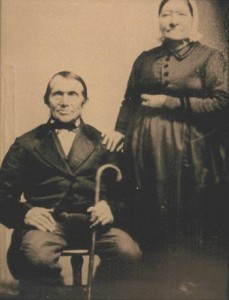
If you're looking for the Dutch origins of your immigrant ancestor, keep in mind that the name originally could have been longer than the name the family used in the new country. Long names were often shortened to make them easier to pronounce in another language. After some of my Esselinkpas cousins emigrated to Michigan in the 1800s, they went by Pas. Some members of the Roerdinkveldboom family went by Veldboom after emigration. Another thing to keep in mind is that there might be family … [Read more...]
Dutch term – Rivier
19 March 2018 by Leave a Comment
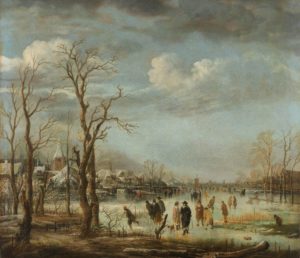
A rivier is a river. The largest rivers in the Netherlands are the Rhine ("Rijn"), Scheldt ("Schelde"), and Meuse ("Maas"). Rivers have always been an important mode of transportation in the Netherlands. Many prosperous cities can be found near rivers. People traveled on rivers in trekschuiten (pulled barges). Emigrants from other parts of Europe used rivers to come to the Netherlands; either to settle, or as transients on their way to America. For example, the Rhine river brought many … [Read more...]
Quick tip – Find Facebook Groups about the Town
7 March 2018 by Leave a Comment
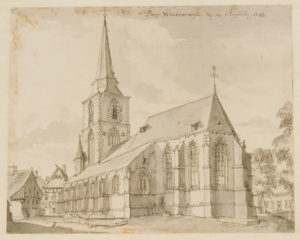
Many towns in the Netherlands have their own Facebook groups dedicated to the history of that town. Many of these Facebook groups are called "Oud [town name]," such as Oud Winterswijk [Old Winterswijk] or Oud Breda [Old Breda]. You can use the Facebook search option to search for these groups. Discussions in these groups are usually in Dutch, but if you have a question about the town history, feel free to post in English. Most people in the Netherlands speak English, and otherwise people are … [Read more...]
Quick Tip – Dutch Ancestors Left Few Last Wills
28 February 2018 by 2 Comments
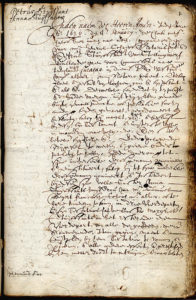
Our Dutch ancestors rarely had a last will drawn up. Most were too poor to have any goods to leave behind. But even people who did own property often did not feel the need to have a last will, since they were happy with the default arrangement under the law. The wills that do exist can be found in notarial records (in areas and periods where notaries were available) or voluntary court records. … [Read more...]
Quick Tip – NGSQ Case Study Now Available Online
21 February 2018 by Leave a Comment
In December 2016, I wrote a case study "Griete Smit's Parentage: Proof in the Absence of Vital Records" that appeared in the National Genealogical Society Quarterly. The case study showed how I researched Griete Smit’s family and neighbors to prove who her parents were. Griete Smit lived in the Dutch town of Bredevoort in the early 1600s, during the Eighty Years’ War. The case study teaches about the types of records that are available for that time and place, and about using local traditions … [Read more...]
Quick tip – Register for the NGS conference in Grand Rapids, Michigan now
7 February 2018 by Leave a Comment
The National Genealogical Society Family History Conference in Grand Rapids, Michigan (2-5 May 2018) will feature several Dutch topics. Dutch Genealogy's Yvette Hoitink will be there as a speaker. Register now for a chance to meet other people with Dutch roots and to learn more about tracing your Dutch ancestors, and many other topics. For the full program and registration, see the NGS conference website. … [Read more...]