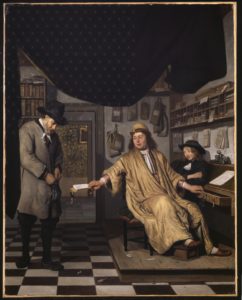
Many notarial records are unindexed and can be time-consuming to go through. But notarial records were often created because of a life event that we can find in other sources. In a small town with just one or two notaries, it can pay off to browse the notarial records around that time. In towns without a notary, these types of records can be found in the series of voluntary court records. Examples of life events that may have created notarial records: Marriages: prenuptual agreements, … [Read more...]
Quick tip – Are There Scans of that Unindexed Record?
12 September 2018 by Leave a Comment
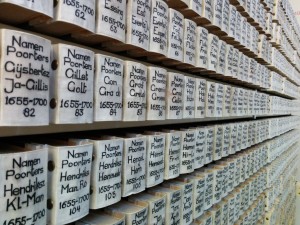
If you can't find a record for your ancestor by searching for their name, see if the records have been scanned but not indexed yet. It's much quicker to scan a record that it is to index it. Indexing requires people to read the names and type them into a database. This is time consuming so millions of records have been scanned without being indexed yet. Unindexed scans can be found via the online finding aids presented by the archives where the records are kept. See the Digital Resources … [Read more...]
Quick tip – Search Family Papers First
5 September 2018 by Leave a Comment
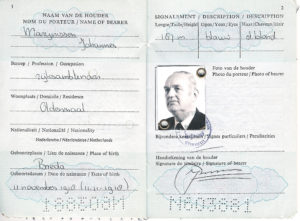
When you're researching a line, first check what records might be available in your family. When I was researching my grandfather Johannes Marijnissen, my mother had several interesting records about him: an old passport, his marriage booklet, military discharge papers, an extract of his death record, and family photos. Since my grandfather was born less than 100 years ago, these family papers provided information that would not have been available to me otherwise. … [Read more...]
Quick tip – Dates in Population Registers May Be Incorrect
22 August 2018 by Leave a Comment
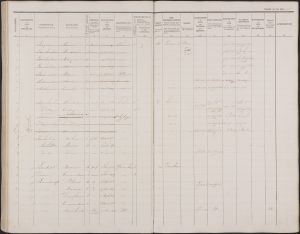
If you're using population registers, keep in mind that these registers were often copied from older registers and may contain copy errors. The birth dates mentioned in them were often not written close to the time of birth, and the informants may have made mistakes. If you find a birth date in a population register, always verify that information using other records. More reliable sources for birth dates are birth records or baptismal records that were created shortly after the birth, with … [Read more...]
Quick tip – Last Name or Patronymic?
8 August 2018 by 2 Comments
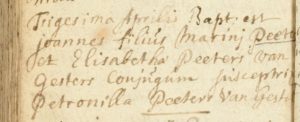
If you're researching a family with a name like Jansen, Zwiers, or Pieterse, at one point you will find the original person for whom the name was not a hereditary last name but a patronymic derived from the father's name. My mother's name is Marijnissen. As a beginning genealogist, it took me a while to realize that the father of her brick wall ancestor wasn't called Marijnissen but had Marijnis as a first name. I found his father as Marinus Peeters. When dealing with such names before … [Read more...]
Quick tip – Find Reusable Images at the Cultural Heritage Service
1 August 2018 by Leave a Comment
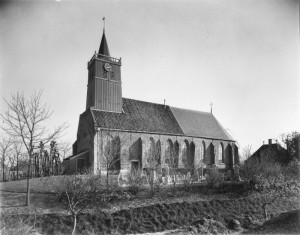
The Rijksdienst voor Cultureel Erfgoed [Cultureel Heritage Service] is a government organization that oversees the care for monuments, archaeology, and museums in the Netherlands. The service has an online image bank with a range of digital images: Photos of monuments and archaeological sites Maps and original indicator tables of the cadastral registration of 1832 Photos of collections of some museums. I often use this image bank to find photos of churches where my ancestors … [Read more...]
Quick tip – Hiding under another name
25 July 2018 by 1 Comment
If your ancestors were from a small town and you can't find their parents, perhaps they're hiding under another name. There wasn't a great influx of new people in a small town, so don't automatically assume that people came from elsewhere if you can't find them. They could be hiding under a different farm name, or their last name could be a patronymic referring to the first name rather than the last name of the father. Or maybe they were the first in their family to use that particular name … [Read more...]
Quick tip – The Legal Father May Not Have Been the Biological Father
4 July 2018 by 6 Comments
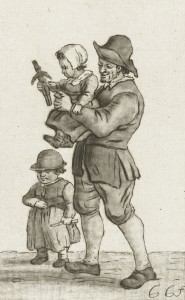
If a child is born out of wedlock, it is possible he or she was later legitimized when the mother married. Legally, the mother's husband would then be the father. But that doesn't mean he was the biological father. In these situations, there are several things you can do to verify if the legal father was also the biological father: You can compare timelines of the mother and the legal father to see if they were in the same place around the time of conception. You can research the … [Read more...]
Quick Tip – Use “Netherlands” rather than Holland or NL
20 June 2018 by 5 Comments
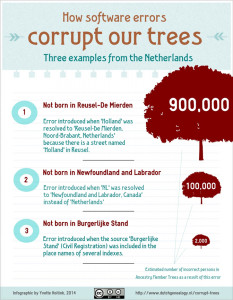
When recording Dutch place names in your genealogy program, use "Netherlands" rather than "Holland" or "NL." "Holland" is not the name of the country, but of a former province, now split into North-Holland and South-Holland. Some programs in the past tried to resolve Holland and ended up changing it to "Reusel-De Mierden, Noord-Brabant, Netherlands" since there is a street called Holland in that tiny village. It led to millions of corrupt trees. "NL" is sometimes used as an abbreviation … [Read more...]
Quick tip – Rijksmuseum Public Domain Images
28 May 2018 by Leave a Comment
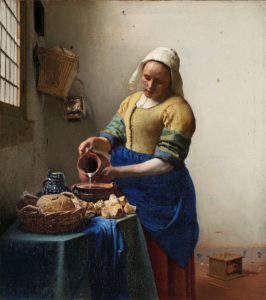
If you're looking for images to illustrate your family tree or give you a sense of what life was like for your ancestors, check out the website of the Rijksmuseum. Many paintings, drawings, and etchings from their collection have been scanned and may be downloaded for free and reused for any purpose since they are in the public domain. Try searching for the name of a town where your ancestors lived, or of an occupation they had. Use the Dutch words, since the collection is described in Dutch. … [Read more...]