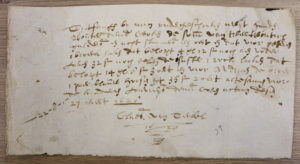
If a person wanted to remarry after becoming a widow(er), they first had to come to an arrangement with the children of the prior marriage. These arrangement are often registered in court records, orphan chamber records, or notarial records, often around the time of the publication of the banns of the second marriage. They can provide a wealth of information about family members and the economic circumstances. See the article about the parents of Aleid Laureijs Coolen. A receipt for her … [Read more...]
Quick tip – Was the Index Scanned?
6 February 2019 by Leave a Comment
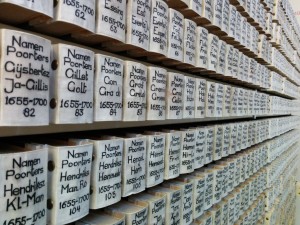
Long before computer databases were invented, people created indexes. Examples of such "manual" indexes include: A list of names at the end of a book or register An index volume (repertorium) with abstracts of records created by a notary A list of grantors and grantees in the back of a deed register A register with muster roll numbers of soldiers in a regiment A list of incoming and outgoing letters of a government agency, organized by sender or recipient A card catalog … [Read more...]
Quick tip – Patronymics May Not Be Easy to Recognize
23 January 2019 by 1 Comment
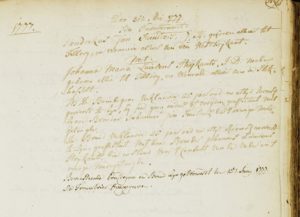
Sometimes it's hard to see the difference between a patronymic and a middle name. One of my ancestors, Hendrik Jan Smulders was called "Jan" because his father was named Jan. At that time, people in Tilburg didn't use a genitive form to indicate patronymics so it's difficult to see if "Jan" is a middle name or a patronymic. In other regions and times, the name might have been Jans, Jansen, Janssen, Janse, or Jansse, which more clearly define it as a patronymic. Another situation where a … [Read more...]
Quick Tip – Crossed Out Does Not Mean Incorrect
26 December 2018 by 1 Comment
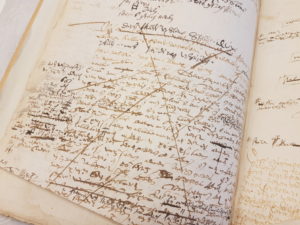
Just because a record or part of a record is crossed out, does not mean it is incorrect. Often, records were struck through when they were no longer valid or needed. For example, a court record about a debt was struck through after the debt was paid, sometimes with a note in the margin about the payment. In population registers, a line was struck through if the person died or moved away. So don't ignore evidence you can find in these records just because the words have been crossed out. … [Read more...]
Quick Tip – Van der Aa’s Gazetteer
12 December 2018 by 7 Comments
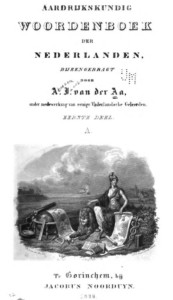
Van der Aa's Aardrijkskundig Woordenboek der Nederlanden or geographic dictionary of the Netherlands is a dictionary in 14 volumes that appeared between 1839 and 1854. It contains descriptions of all geographical names in the Netherlands. For cities, towns, and villages, it will give a description of its location, the population including the dominant religions, the main industry and occupations in a town, and any peculiarities Van der Aa found worth mentioning. This gazetteer can be helpful … [Read more...]
Quick tip – Are the Pages in the Right Order?
28 November 2018 by Leave a Comment
For an article I'm working on, I was studying a woman's neighbors to see if their records could help me identify her parents. I noticed that the neighbors in a transcription that I used were different from the neighbors on the scans on the archive's website. It turns out the transcription had transcribed the pages in a different order. The person of interest was at the bottom of the page, so the next-page neighbors in the transcription were different from the neighbors in the scans. Further … [Read more...]
Quick Tip – Check for Marriage Booklets in Your Family
21 November 2018 by Leave a Comment
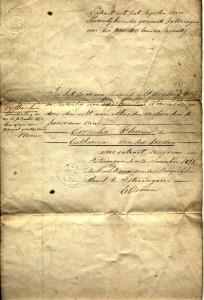
If your family lived in the Netherlands after say 1850, check your family papers to see if there is a marriage booklet ("trouwboekje"). These booklets are given to the spouses during the marriage ceremony and record the information about the spouses. It is then updated when children are born or when the spouses die. See the article about my mother's descent from her father Jan Marijnissen for an example of using a marriage booklet. … [Read more...]
Quick Tip – Names are Different in Latin
31 October 2018 by 1 Comment
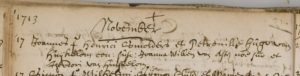
If your family was Roman Catholic, their church records will be in Latin. These records used the Latin version of names. Since Dutch search engines only find exact matches, you will need to search for these Latin names or use wildcards. For example, my ancestor Jan Smulders appeared in Catholic records as Joannes. His father Hendrik is called Henricus in Latin. Searching for "Jan Smulders" would not have found his baptismal record, but J* Smulders would have. Even initials can change though; … [Read more...]
Quick tip : Upload your DNA to MyHeritage. Now!
24 October 2018 by Leave a Comment
MyHeritage allows you to upload your autosomal DNA results from other companies. This is a currently a free service, but after 1 December 2018, advanced features will be paid. If you upload now, these services will remain free. Upload your DNA now! If you upload after 1 December 2018, you will still see your matches but you won't be able to use the chromosome browser or see ethnicity predictions. The chromosome browser is particularly useful since you can then see if multiple people match … [Read more...]
Quick Tip – Unexpected Nicknames
10 October 2018 by 11 Comments
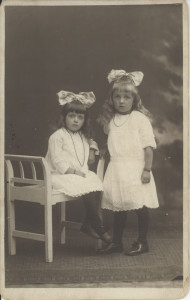
My grandmother's official name was Catharina Flooren, but she was known as "Toos." That's a common derivative of Catharina, which came about via Catharina > Cato > Toos. Other examples of nicknames that might seem surprising are Mees for Bartholomeus, Elen for Aleida, and Nel for Petronella or Cornelia. Especially before the introduction of the civil registration, you can find people in records under different variations of their names. To find out other forms of a name, you can … [Read more...]