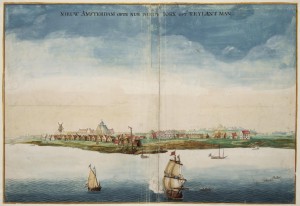
The Dutch East India Company and West India Company attracted workers from all over Europe. Many came from the German states or the Baltic. So if your ancestor was employed by one of these companies and settled in the West Indies, South Africa, New Netherland or the East Indies, it is possible that they were not Dutch at all. … [Read more...]
Quick tip – Naming Traditions May Vary
7 October 2015 by Leave a Comment
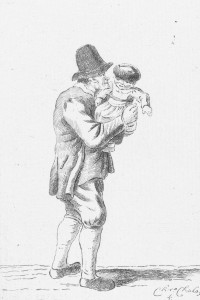
Many genealogists know that Dutch children were usually named after their grandparents. But the order in which children were named can vary between regions, religions and also in different periods. In some cases, the maternal grandmother took precedence over the paternal grandmother. Also, parents sometimes only named children after deceased family members. For example, in the eastern part of Gelderland I found that in the 1600s, most families only named children after the grandparents if … [Read more...]
Quick tip – The Dutch Language Changed a Lot
30 September 2015 by Leave a Comment
The Dutch language changed a lot these past centuries. It's not just the script - the words themselves changed a lot too. Most Dutch people today struggle to understand a text from the 1600s, even if it's reprinted. This explains why automatic translators like Google Translate or Chrome struggle to understand archaic Dutch. They often don't produce anything that is comprehensible in English, and may change the meaning. The correct interpretation of all terms in a document is often vital to … [Read more...]
Quick tip – Ask a Local Expert
23 September 2015 by Leave a Comment
If you're really stuck, try finding someone who is familiar with research in the area and ask them to take a second look at your brick wall. They may know about local naming traditions, obscure sources or notice unusual patterns. Just this week I was able to solve a client's brick wall using the knowledge of a local expert. I traced the New Netherland ancestor back to his home town, and then consulted a local expert. Within hours, he found a record that placed the New Netherland immigrant in … [Read more...]
Quick tip – Was your ancestor the first to use the surname?
9 September 2015 by 1 Comment
Let's say you've gone all the way back to the 1500s, 1600s or 1700s and can't find the parents of your brick wall ancestor. Could it be that your ancestor was the first one to use the name? Perhaps your Van Etten really was from Etten, and his parents only used a patronymic. Perhaps your Hoitink ancestor was born on another farm, and only called himself Hoitink after he married a Hoitink daughter and moved into her farm. Perhaps your Marijnissen ancestor was the son of Marijnis, whose … [Read more...]
Quick tip – Dutch Genealogy Webinar
2 September 2015 by 1 Comment
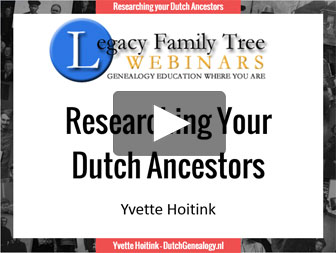
On Wednesday 16 September, I'll give a webinar about "Researching Your Dutch Ancestors." I hear the virtual seats are filling up quickly so grab yours while you can and register today. See the Legacy Family Tree Webinars website for more information and registration. Tip: If you are a Family Tree Webinar Subscriber or purchase this webinar after it airs, you can watch the episode whenever it suits you and you can download the syllabus. The syllabus contains ten pages of links, tips, … [Read more...]
Quick tip – Wiring money to the Netherlands
26 August 2015 by 1 Comment
If you're ordering records from municipalities or archives in the Netherlands, chances are that you will not be able to pay by credit card or PayPal. Most government agencies in the Netherlands are only set up to accept bank payments. To wire money, you will need the IBAN-number of the bank account that you're sending the money to, and the SWIFT-number of the bank. If you live in the European Union, wiring money is free, but if you live outside the EU, it could be expensive. A cheaper … [Read more...]
Quick tip – Turn the page!
19 August 2015 by Leave a Comment
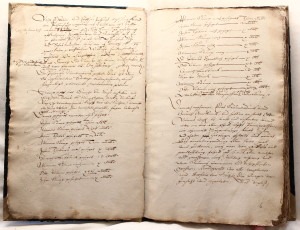
In Dutch records, often only the right page is numbered. So if you see a reference for your ancestor at page 15 and can't find her, turn the page and check the left side of page 16. Often, this reverse page is designated like fol. 15v, with a v for "verso" [Latin for reverse] and "fol." [folio] instead of p. [page]. But sometimes the numbers look like regular page numbers and don't give a clue that the record could be on the reverse page. One place where I've noticed this happening is in … [Read more...]
Quick tip – Not all religions baptized infants
12 August 2015 by Leave a Comment
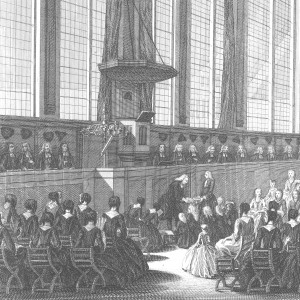
In the period before the civil registration, which was introduced in most of the Netherlands in 1811, baptismal records are the usual documents to consult for information about the birth date of an ancestor. In most cases, children were baptized within days of being born. But some religions did not baptize infants but waited until people were old enough to make an informed decision about joining the church. In the Netherlands, the main church that baptized adults was the Anabaptist or … [Read more...]
Quick tip – Always check the original record
5 August 2015 by 2 Comments
My client wanted me to find interesting stories about her ancestors. Normally, that would have me scouring newspapers and court records, but only after I find the basic information about birth, marriages and death. The civil registration records are not the first place you would think to look for interesting stories, but sometimes they will give you the first hint. I found the date and place of birth of one of her ancestors in the extract of his birth record in the marriage supplements. A … [Read more...]