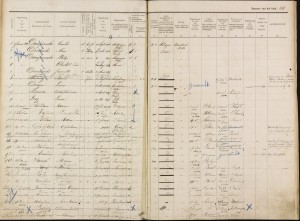
Population registers can be difficult to understand, because one page can have information about people at different times. This can be especially confusing for people who are used to dealing with census records. Here's an analogy that might help you: Census records are like snapshots, population registers are like movies. Population registers record what is going on with a family over a period of time, usually about ten years. By reading the lines from top to bottom, you will see who … [Read more...]
Quick tip – Check your photos. Again.
25 February 2015 by 3 Comments
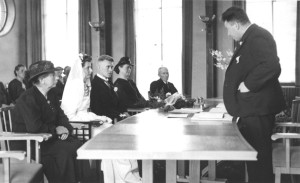
Last week, I wrote a post about What spouses promised each other, in which I used a photograph of my grandparents' wedding. When browsing my Facebook feed, the story came up and I looked at the photo just like I would at any other photo. And there he was. My great-great-grandfather. Next to my grandfather sits his mother. Then, an empty seat, where his father should have been (he died six months before the marriage). But the next chair is occupied by an elderly man. Who else could … [Read more...]
Quick tip – Not many Dutch DNA cousins
18 February 2015 by 22 Comments
When you take a DNA-test for genealogical purposes, don't be surprised if you don't find many Dutch matches. Because DNA testing isn't very popular in the Netherlands, there will be few Dutch people in the databases. So not finding many Dutch matches doesn't mean that your paper trail that shows a Dutch ancestor is wrong. Why DNA testing isn't popular in the Netherlands I think there are several reasons for this: Many people are unaware of the possibilities that DNA can offer. If they … [Read more...]
Quick tip – Your ancestors may have gotten older than you think
11 February 2015 by 1 Comment
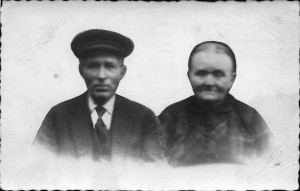
Many people think that people died a lot younger in earlier centuries. While poor healthcare, contagious diseases, risks of childbirth and dangers at sea certainly took many of our ancestors before their time, several of them lived to be quite old. The main reason that the average lifespan was shorter than today is because of infant mortality. But none of our ancestors died as a child: all of them lived long enough to produce offspring or they would not have been our ancestors. Their … [Read more...]
Quick tip: Reading Dutch handwriting (video)
4 February 2015 by 1 Comment
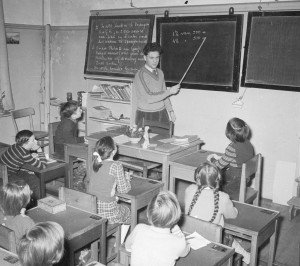
Familysearch has three free videos that teach you the basics about reading Dutch handwriting: Reading Dutch Handwritten Records Lesson 1: The Dutch Alphabet Reading Dutch Handwritten Records Lesson 2: Dutch Words and Dates Reading Dutch Handwritten Records Lesson 3: Reading Dutch Records … [Read more...]
Quick tip – Visit the virtual Jewish monument
27 January 2015 by Leave a Comment
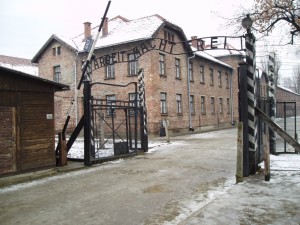
Today we commemorate that Camp Auschwitz was liberated 70 years ago. I visited the camp with my class in high school and it made a lasting impression on me. We saw rooms packed with children's shoes, toothbrushes, toys, and then read that it was just 1% of the total number that had been collected. Each one representing a tragic story. The website Jewish Monument tries to show each of these stories of the Dutch victims of the Holocaust. On the homepage, one dot represents each victim: blue for … [Read more...]
Quick tip – Most people did not own real estate
21 January 2015 by 1 Comment
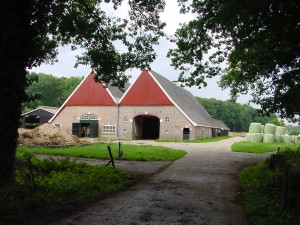
Historically, most people in the Netherlands did not own real estate. Most farmers were tenant farmers, often living on the same farm for generations. Others were seasonal laborers who moved from farm to farm every year. It is rare to find tenancy contracts or rental agreements as these things were usually arranged between the owner and the tenant without registration by a notary or court. In cities, many workers were too poor to own their own house and would have rented a room or house. … [Read more...]
Quick tip – research the collateral lines
14 January 2015 by 1 Comment
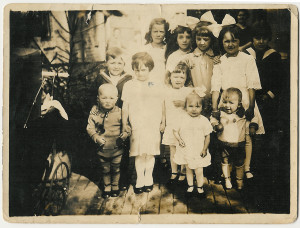
Most people are more interested in ancestors than their siblings, but records of the siblings can contain vital clues. For example, death duties files (memories van successie) of siblings who died without children can show that nieces and nephews or more distant relatives inherited. The death duties files can reveal complex family relationships, especially in the case of an elderly person who died after their siblings. Another tip is to always check the marriage supplements of marriages of … [Read more...]
Quick tip – Records that just became public
6 January 2015 by Leave a Comment
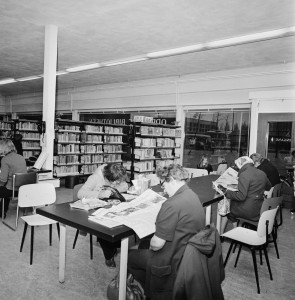
To protect the privacy of living people and the security of our nation, access to many records is restricted for a number of years; typically 25, 50, 75 or 100 years. Every year, new records become public for the first time. As of 1 January 2015, the following records became public: Birth records from 1914 Marriage records from 1939 Death records from 1964 This does not mean that all the records will immediately be scanned and put online, just that you can access them at the … [Read more...]
Quick tip – TEDx talk about New Netherland history
31 December 2014 by Leave a Comment
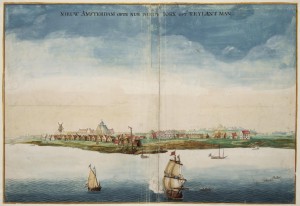
Charles Gehring, the lead researcher at the New Netherland Institute, gave an enlightening presetation at TEDx about New Netherland, the best-kept secret in American History, which is now available on YouTube. Hattip: Limburg Emigrant Page on Facebook. … [Read more...]