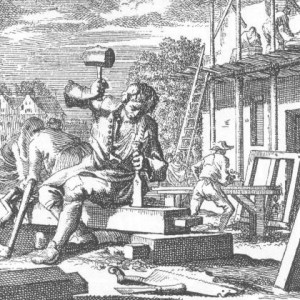
A knecht is a term used to describe the occupation of somebody who works for somebody else. The term does not have an exact English equivalent, but terms like servant, hand, apprentice or assistant come close. Often, the type of knecht is specified, for example timmermansknecht (carpenter's hand), bakkersknecht (baker's hand) or landbouwersknecht (farmhand). Most men started out working as a knecht to learn a trade. Some became masters in their own right, others remained a knecht for the rest of … [Read more...]
Dutch term: lidmaat
22 July 2013 by Leave a Comment
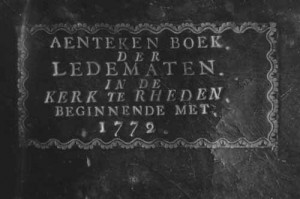
The word lidmaat (plural: lidmaten, sometimes ledematen) means member, usually a member of a protestant church. Most protestant became members by confessing around the age of 18-20. Their membership is recorded in the lidmatenboek (church membership book). If they moved, they were given a declaration by their old church so they could become members of another church without having to confess again. … [Read more...]
Dutch term: kwartierstaat
15 July 2013 by Leave a Comment
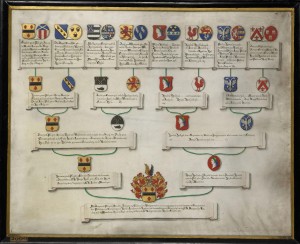
The word kwartierstaat (literally: table of quarters) means ahnentafel, an overview of all ancestors in male and female lines. Many Dutch genealogists publish their kwartierstaat online. Searching for kwartierstaat plus a family name in a search engine like Google may give interesting results. … [Read more...]
Dutch term: jongedochter
8 July 2013 by Leave a Comment
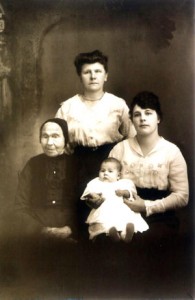
"Jongedochter" literally means "young daughter". The term is most often used in marriage records, to indicate that the bride was a spinster; somebody who had not married before. Even though the word jong suggests differently, the use of the term had nothing to do with the age of the bride: even spinsters in their 50s could be called jongedochter. … [Read more...]
Dutch term: kadaster
1 July 2013 by Leave a Comment
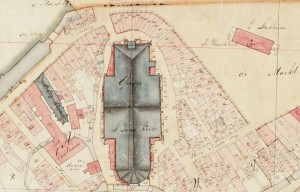
The kadaster is the government body responsible for the registration of property (real estate). Introduced in 1832, the kadaster records the owners of all plots of land and ships. In addition, the kadaster records any rights attached to the property and any mortgages against the property. The kadaster information is used as the basis for property tax. … [Read more...]
Physical descriptions in military records
10 July 2009 by Leave a Comment
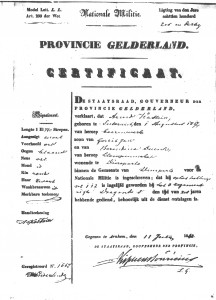
As part of the appendices to a marriage record, the groom had to submit proof that he had fulfilled his military duties. This certificate of the National Militia often contains a physical description. In some cases, the physical description is left blank, for example if the man did not have to serve because he had brothers in the army already. This article will give an overview of the most frequent Dutch terms and their translations. … [Read more...]
Search forms
31 March 2007 by 2 Comments
There are many Dutch websites out there that provide access to genealogical records. Many of them use a search form that is available in Dutch only. Knowing the standard terms will enable you to use these forms. … [Read more...]
Dates and times
9 May 2005 by Leave a Comment
List of terms you need to translate dates and times. Note on dates: Dutch dates are written in the form dd-mm-yyyy, so 2-5-1920 means 2 May 1920. … [Read more...]
Family relationships
5 May 2005 by Leave a Comment
This page lists the Dutch words for family members and their English translation. … [Read more...]
Genealogical terms
12 April 2005 by 4 Comments
This page lists some Dutch words that appear frequently in genealogical records and publications. … [Read more...]