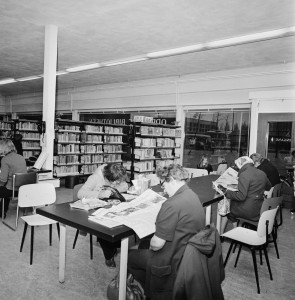
To protect the privacy of living people and the security of our nation, access to many records is restricted for a number of years; typically 25, 50, 75 or 100 years. Every year, new records become public for the first time. As of 1 January 2015, the following records became public: Birth records from 1914 Marriage records from 1939 Death records from 1964 This does not mean that all the records will immediately be scanned and put online, just that you can access them at the … [Read more...]
Dutch term – Overspel
5 January 2015 by Leave a Comment
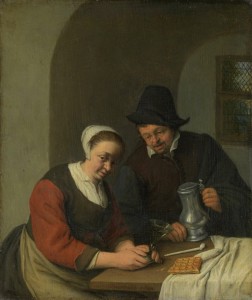
Overspel is the Dutch word for adultery. Depending on the period, adultery was not only a private matter, but could be criminally prosecuted. The church council also wanted to find out so that both parties could be censored. One of my own female ancestors was fined for insulting another woman, saying "You are keeping company with my man" and other more derogatory terms. As far as I know, the husband or the woman he was having an affair with were never prosecuted. Stories like these sure help … [Read more...]
New Year’s irons in the East of the Netherlands
1 January 2015 by 6 Comments
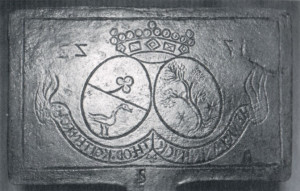
Happy New Year everybody! How are you celebrating? In the eastern part of the Netherlands, in the provinces of Groningen, Drenthe, Overijssel and Gelderland, there is a tradition of baking New Year's waffles on New Year's Day. Traditionally, these waffles were made using large irons which were put in the hearth. In 1999, my mother co-authored a book about these New Year's irons, for which I took photographs and did research. Several of these irons contained names and I helped to find out who … [Read more...]
Quick tip – TEDx talk about New Netherland history
31 December 2014 by Leave a Comment
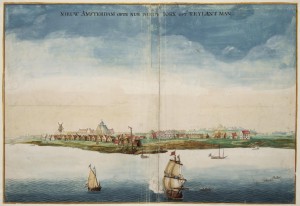
Charles Gehring, the lead researcher at the New Netherland Institute, gave an enlightening presetation at TEDx about New Netherland, the best-kept secret in American History, which is now available on YouTube. Hattip: Limburg Emigrant Page on Facebook. … [Read more...]
Dutch term – Topics in an Archievenoverzicht
29 December 2014 by Leave a Comment
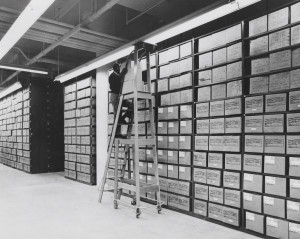
An archival catalog (archievenoverzicht) will give an hierarchical overview of the contents of a repository. Common topics include: Bestuur en Politiek [Government and politics] Bevolking [Population] Justitie en Rechtspraak [Justice and Court] Openbare orde en veiligheid [Public order and safety] Defensie [Defense] Notariaat [Notaries] Financiën [Finances] Verkeer en Waterstaat [Traffic and Waterways] Ruimtelijke ordening [Urban planning] Sociale zorg, welzijn … [Read more...]
Looking back on 2014
26 December 2014 by 2 Comments
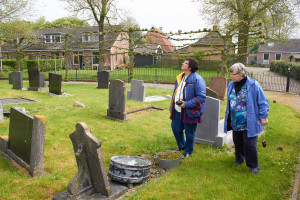
2014 has been a wonderful year for me. It's the year my company Dutch Genealogy Services really took off, which allowed me to quit my job and dedicate myself full-time to being a genealogy professional. Here are some of the highlights of my year. Client projects Worked for 35 clients from 12 different countries. Did research in 11 of the 12 provinces in the Netherlands. The only province I did not do any research in was Flevoland, a province that only was established in 1988 so not … [Read more...]
Quick tip – Find out what’s in WieWasWie
24 December 2014 by Leave a Comment

In discussion groups, I will often see people wondering why they can't find their ancestors' records in WieWasWie (WhoWasWho). WieWasWie is the largest website with genealogical sources in the Netherlands, a collaboration between dozens of repositories throughout the country. It has over 100 million references to people in the database, but is far from complete. Each repository has its own schedule on how they enter information. They all started with the marriages and most continued with the … [Read more...]
Dutch term – Midwinterhoorn
22 December 2014 by 2 Comments
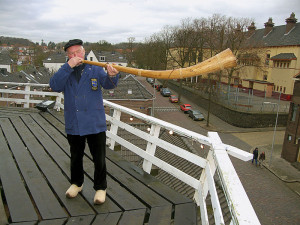
Midwinterhoorn literally means "Mid winter horn." It is a wooden horn that is typical for the eastern part of the country. The horns are made of a curved branch of a tree, which is sawed in half length-wise, hollowed out and put back together with a mouth piece attached to it. In Gelderland and Overijssel, midwinterhoorns are traditionally played during the Advent season. They are often played over a well, to amplify the sound, which can carry over miles and miles. For me, … [Read more...]
5 lessons we can learn from Who Do You Think You Are?
19 December 2014 by 11 Comments
In the US, the new series of the TV show Who Do You Think You Are? was just announced. I am a big fan of the show. I watch three different series: the original UK version, the US version and the Dutch version ("Verborgen Verleden"). Although they all share the same basic format, it is interesting to see the differences. The US version is more about the human interest, the UK version is more about the historical context and the Dutch version often seems to try to cram as many stories into one … [Read more...]
Quick tip – Recent information is not online
17 December 2014 by 2 Comments

If you're trying to find information about people born in the last century, you won't find much online. Dutch privacy laws restrict access to records of people born less than hundred years ago. To access these records, you will need their consent or proof of death. Information doesn't come online the minute it's 100 years old either. Not all archives put their birth, marriage and death records online, and those that do do not always immediately scan or index the records. Some archives choose … [Read more...]