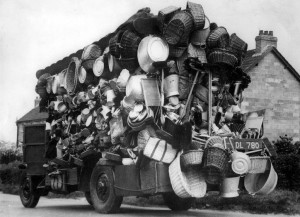
Your ancestors may have moved around a lot more than you think. Especially towards the end of the 19th century, when more and more people started living in cities, people moved a lot more frequently than we do today. Check this case study, for example, that shows how one woman moved 28 times in 20 years. … [Read more...]
Dutch term: Memorie van Successie
27 May 2014 by Leave a Comment
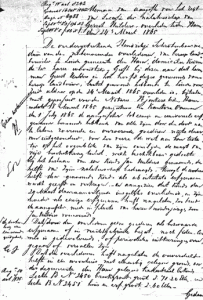
A Memorie van Successie (literally: memorial of succession) is a death duties file. To determine the inheritance tax due after a person died, the heirs had to file a Memorie van Successie. Read more about Death Duties Files and how to use them for your research. … [Read more...]
A tale of two calendars
23 May 2014 by 1 Comment
Almost everywhere in the world today, we use the Gregorian calendar. It has 365 days a year, with the occasional leap year that is determined as follows: Every year that is exactly divisible by four is a leap year, except for years that are exactly divisible by 100, but these centurial years are leap years if they are exactly divisible by 400. For example, the years 1700, 1800, and 1900 are not leap years, but the year 2000 is.1 This calculation of the leap years make sure that the average … [Read more...]
Quick tip: naming patterns
21 May 2014 by 3 Comments
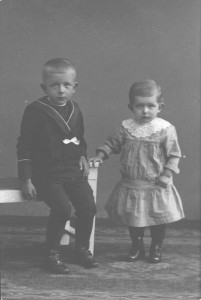
Most Dutch parents followed a strict pattern when naming their children: the first son was named after the paternal grandfather, the second son after the maternal grandfather; the first daughter was named after the maternal grandmother and the second daughter after the paternal grandmother. When you find a source that lists children in their birth order, this could be a big clue about the names of their grandparents. Even Dutch immigrants usually followed this pattern so the names of children … [Read more...]
Dutch term: Molenaar
20 May 2014 by Leave a Comment
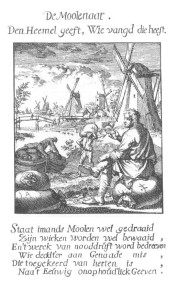
A molenaar was a miller. There were different types of mills. Besides the classic Dutch wind-powered mill, there were also horse-drawn mills and water mills. Mills could be used for different purposes, the most common being grind grain or to drain water from low-lying fields. People could not just build a mill, that right was reserved for the landlord. Before the 19th century, most millers did not own the mills that they worked, but worked for the landlord. The French occupation put an end to … [Read more...]
Worst case of pedigree collapse ever?
16 May 2014 by 57 Comments
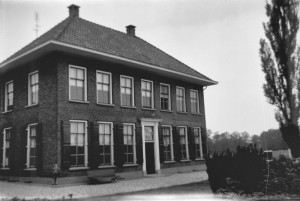
My father's side of the family comes from a small village in the east of Gelderland called Winterswijk. Because so many of his ancestors came from that place, I am reconstructing its entire population. Doing such a one-place-study has given me a deeper understanding of life in that village and allowed me to make some interesting discoveries and observations along the way. Roerdink family from Winterswijk One of the families I am researching, the Roerdinks, belonged to the farmer elite of … [Read more...]
Quick tip: Using the website WhoWasWho (video)
14 May 2014 by Leave a Comment

Familysearch has created a free video about using the largest genealogical database in the Netherlands: WieWasWie [WhoWasWho]. 7 minute video: Using the Dutch Website: Whowaswho … [Read more...]
Dutch term – Bloeimaand
12 May 2014 by Leave a Comment
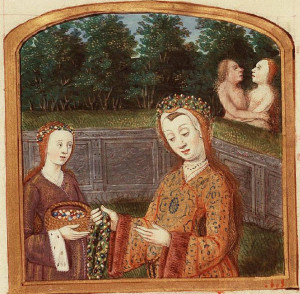
Bloeimaand (literally: bloom month) is the old word for May. … [Read more...]
Quick tip: try spelling variations
7 May 2014 by Leave a Comment

Even after the introduction of the civil registration, but especially in earlier records, there may be spelling variations of a name. A woman may be called Elizabeth or Elisabeth, her last name might be written as Jansen or Janssen. Especially since most Dutch search engines only find exact matches, it is important to try different spelling variations or use wildcards. A search for Eli* Jans* would have found all four variations of the name. If you can't find a person, also search for … [Read more...]
Dutch term – Bevrijding
5 May 2014 by Leave a Comment
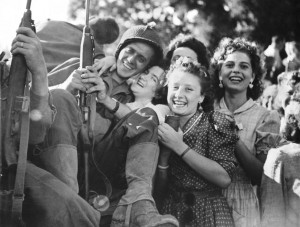
Bevrijding means 'liberation.' On 5 May 1945, the Netherlands was liberated from the German occupation. Every year on this day, we celebrate "Bevrijdingsdag" (Liberation Day) to commemorate this event. … [Read more...]