A tussenvoegsel (literally: something put in between) is a prefix of a surname. Common prefixes are De (the) or Van den (from the). Tussenvoegsels are ignored when determining the alphabetical order, so De Vries can be found under the V. See the article about prefixes in surnames for more information. … [Read more...]
Marriage supplements: gateway to more information about your ancestors
23 August 2013 by 4 Comments
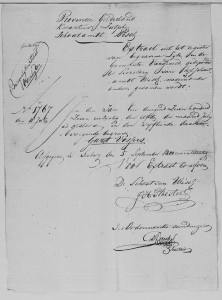
Since the introduction of the civil registration in 1811, a bride and groom had to submit several documents to prove they were eligible to get married. Not only do these records tell you when your ancestors were born, but they may also provide information about their physical appearance, death dates of parents and previous spouses or even of their grandparents. These documents are known as the 'Huwelijksbijlagen' and most of them still exist and can be found online. … [Read more...]
Quick tip: privacy laws
21 August 2013 by Leave a Comment
Privacy laws in the Netherlands are very strict. The law does not permit publication of information about people who may still be alive without their consent. As a rule of thumb, information for people born less than 100 years ago is not public and should not be available online. The same applies to official records. Birth records are public until 1912, marriage records until 1932 and death records until 1962. After these dates, only the persons themselves can access the records (or … [Read more...]
Dutch term: Landverhuizer
19 August 2013 by Leave a Comment
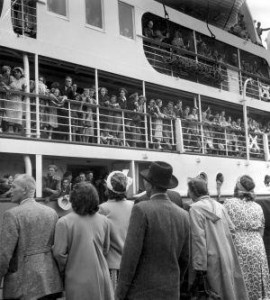
The word landverhuizer means somebody who moved to another country. It's the term most 19th century records use when referring to emigrants. Knowing this term can help to find lists of emigrants ("staten van landverhuizers") in catalogs of repositories. Read more about landverhuizers in the column "Land movers." … [Read more...]
Top 10 most common Dutch surnames
16 August 2013 by 62 Comments
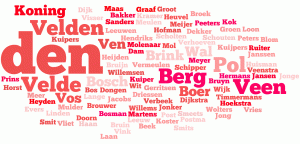
The ten most popular surnames in the Netherlands in 2007 were De Jong, Jansen, De Vries, Van den Berg, Van Dijk, Bakker, Janssen, Visser, Smit and Meijer. More than 5% of the people in the Netherlands had one of these ten last names. 1. De Jong (86,534 in 2007) De Jong literally means "The Young". Often used when two people in the same family had the same first name. The youngest one would be called De Jong, similar to somebody who is called "junior". Its counterpart, De Oude (the … [Read more...]
Quick tip: using genealogical search engines
14 August 2013 by 5 Comments

Did you know that most genealogical websites in the Netherlands use a different search strategy than websites in the US? Most Dutch websites only find results that are a perfect match for your query. Each term you fill in acts as a filter for the results set and limits the chance of finding anything useful. The more you fill in, the less you find! This is different than most international websites, where approximate matches are also shown, with the best matches appearing first. If you use a … [Read more...]
Dutch term: schoonvader
12 August 2013 by Leave a Comment
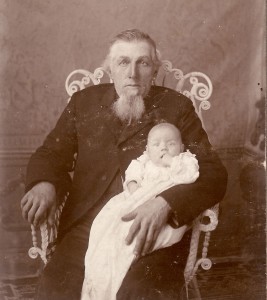
The current meaning of the term schoonvader is "father-in-law." In earlier records, the term is used more generally and can also mean stepfather. Just think of the term as "father by marriage," the marriage being either the one to the spouse (making his/her father the schoonvader) or the mother (making her husband the schoonvader). … [Read more...]
How to order my own birth certificate from the Netherlands?
9 August 2013 by 97 Comments
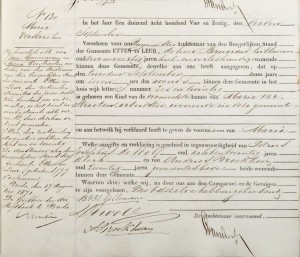
Almost every week, I get a question by someone who needs help obtaining his birth certificate from the Netherlands. Often, these are people who were born in the Netherlands but moved away and now need a birth certificate to get married or apply for citizenship. Since this is not a service I provide, I thought I'd explain how you can order your birth certificate yourself. Birth records for people born less than 100 years ago are not public. Birth records younger than 100 years are kept by the … [Read more...]
Quick tip: Free access to Dutch-American newspapers
7 August 2013 by Leave a Comment
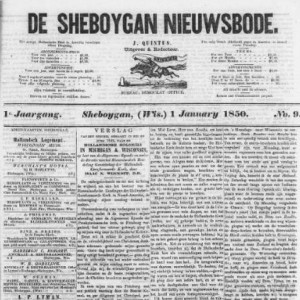
The Royal Library of the Netherlands has a website Delpher that provides free access to historical newspapers. Six Dutch-American newspapers have been added to the site: Sheboygan Nieuwsbode (1849-1861) De Grondwet (1883-1938) De Volksvriend (1892-1938) De Volksstem (1890-1911) Het Oosten (1914-1936) Onze Toekomst (1925-1927 and 1945-1952) The missing years will come online later this year. … [Read more...]
Dutch term: ondertrouw
5 August 2013 by 2 Comments
"Ondertrouw" is the event when the banns for a marriage are published. Following the ondertrouw, the marriage is announced three times, at least a week apart (usually on 3 consecutive Sundays). If nobody objects, the marriage is usually performed shortly after the third publication of the banns. Banns were published in the place where the bride and groom lived. If they only lived there shorter than 6 months, they also needed to be published in their previous place of residence. It is not … [Read more...]