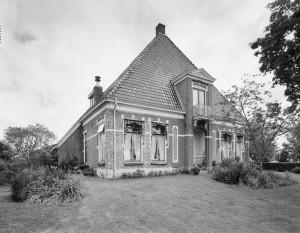
In the province of Friesland, a proclamatieboek is a register in which the court records the proclamations of real estate sales that took place. This allowed people who had Naastingsrecht the opportunity to match the purchase price and buy the property for themselves. Proclamatieboeken can be found in the archives of the local courts, which are kept at the provincial archives of Friesland, Tresoar. The Friends of the Frisian Archives (Stichting FAF) have created indexes and abstracts of some … [Read more...]
Dutch term – Landloper
14 September 2015 by 3 Comments
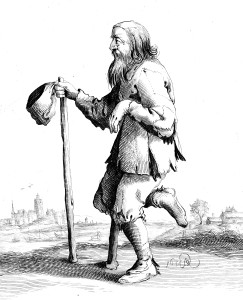
A landloper was literally a "land walker," a vagrant who roamed the countryside. Vagrancy used to be a crime, and vagrants could be incarcerated or banned. Some regions employed special "armenjagers" [pauper hunters] to drive them away. … [Read more...]
Dutch term – Loteling
7 September 2015 by 1 Comment
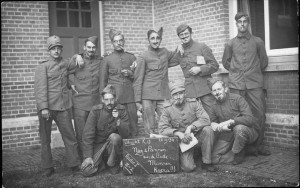
A loteling was a conscripted soldier, whose number came up. This 19th century term literally means "lottery person," which refers to the lot numbers that were assigned to all eligible young men. The ones with the lowers numbers had to serve. Until 1896, you were allowed to switch numbers, and the person who had to serve in another's place would be called a nummerwisselaar. … [Read more...]
Dutch term – Particulier
31 August 2015 by Leave a Comment
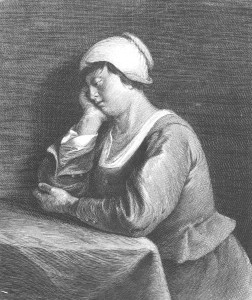
A particulier is a private person, someone not working for the government and not a business. For instance, when you buy something, it is important whether you buy it as a particulier (consumer) or as a business since your warranty may be different. In some records, the term was used to indicate a person who did not receive an income from current employment or running a business. This does not necessarily mean that the person was unemployed or poor, it could also be a person of independent … [Read more...]
Dutch term – Schepel
24 August 2015 by Leave a Comment
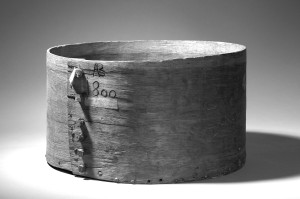
A schepel is a measure of surface as well as of capacity. One schepel of land used to be the amount of land you could sow with one schepel of grain. You may encounter the term in land records or tax records. The size of a schepel differed from one region to the next. For example, in Gelderland, a schepel of land was about 1450 m2, or 0.36 acres. In Twente, a schepel was about 887 m2 or 0.22 acres.1 Source "Schepel (oppervlaktemaat)," Wikipedia, … [Read more...]
Dutch term – Dood
17 August 2015 by Leave a Comment
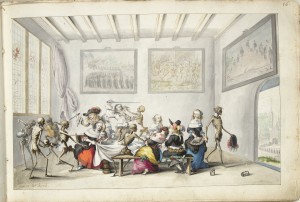
The word Dood means dead or deceased. Information about deaths can be found in death records (after 1811) or burial records (before 1811). In most cases, it will not be possible to find a cause of death. … [Read more...]
Dutch term – Archiefstuk
10 August 2015 by Leave a Comment
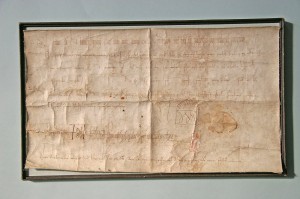
An Archiefstuk is an archival record, a document created or received in the course of a person or organization's activities or tasks. The oldest surviving archiefstuk in the Netherlands is a 950 charter whereby King Otto I granted the right of a market and toll to Cassalum (unidentified location). The charter is kept by the Regionaal Historisch Centrum Limburg. … [Read more...]
Dutch term – Gezel
3 August 2015 by Leave a Comment
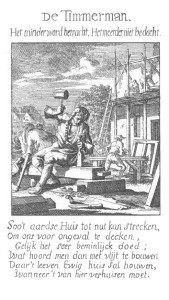
A gezel is a journeyman, a craftsman who had already finished basic training but had not passed his master's exam yet and had not been admitted to the guild. The term is also used to indicate someone who worked for a boss rather than having their own shop, so a gezel doesn't mean the person is young. You can find the word gezel used as a suffix to other occupations, for example a timmermansgezel (journeyman carpenter) or schoenmakersgezel (journeyman shoemaker). You won't find these composite … [Read more...]
Dutch term – Doodgraver
27 July 2015 by 1 Comment
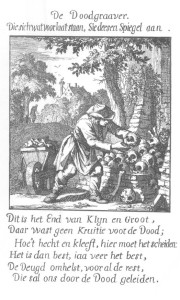
The term doodgraver literally means 'dead digger.' It is the person who digs the graves for the dead. In larger towns, this was a full-time occupation. In small towns, the church sometimes hired poor people to dig the graves, making them work for their allowance. A grave digger was not only supposed to dig the graves but also to collect any bones that would surface before the dogs could get to them. These bones would often be stored in a 'knekelhuisje' [bone house] in the corner of the … [Read more...]
Source – Staten van Landverhuizers
24 July 2015 by 5 Comments
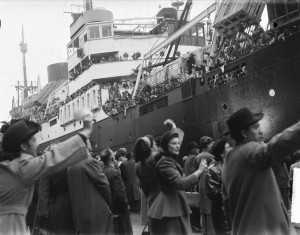
In the 1840s, when religious tensions were high and crops were failing, many people left the Netherlands to start a new life in America. The national government wanted to know what was going on. Since 1848, they required each province to keep lists of emigrants, the "Staten van Landverhuizers" [tables of emigrants]. Between 1831 and 1847, only numbers were recorded, but since 1848 the heads of households were listed. Contents of the Staten van Landverhuizers The provincial lists were compiled … [Read more...]