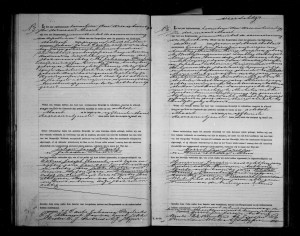
A vondeling is a foundling, an abandoned child whose parents are unknown. It was rare for children to be abandoned. Most cases where children were abandoned took place in the city, not in the countryside. Most abandoned children were raised in orphanages or were placed in a home while the city poor relief paid for their upbringing. Example: Johanna Frederiks Johanna Frederiks was the second wife of my ancestor Johan Jacob Tanto. When they got married in Enkhuizen on 23 March 1817, the … [Read more...]
Dutch term – Hooimaand
7 July 2014 by 2 Comments
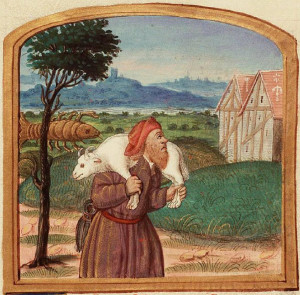
Hooimaand (literally: hay month) is the old word for July. … [Read more...]
Dutch term: Neef en Nicht
30 June 2014 by Leave a Comment
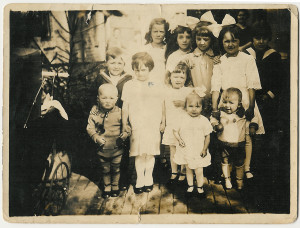
A neef is a male relative: either a first cousin or a nephew. A nicht is a female relative: either a first cousin or a niece. Like the word 'cousin' in English, the words 'neef' and 'nicht' are sometimes used to describe a more distant relationship. Someone who is referred to as a 'neef,' may turn out to be the husband of a first cousin once removed. Because of the Dutch tradition to name people after relatives you will often find several 'neven' and 'nichten' with the same first (and … [Read more...]
Dutch term – familiewapen
24 June 2014 by 7 Comments
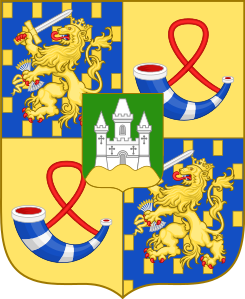
A familiewapen is a family crest or coat of arms. Most people in the Netherlands did not have a coat of arms. People who used them were usually members of the nobility or other members of the upper class. Working class families did not have a use for a crest. There are several heraldic databases and collections that will tell you whether a coat of arms exists for a particular name. Even if you find a crest for your name, that does not mean that your family ever had any right to use it, as … [Read more...]
Quick tip: “levenloos” is not a first name
18 June 2014 by Leave a Comment
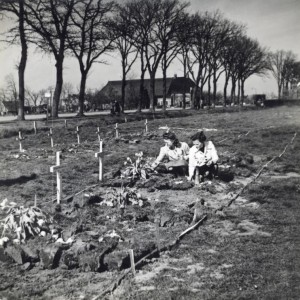
In some trees, you will see the name 'Levenloos' as the first name. However, 'levenloos' means 'lifeless' and is used to indicate stillborn children. Read more about the term levenloos. … [Read more...]
Dutch term – Vader
15 June 2014 by Leave a Comment
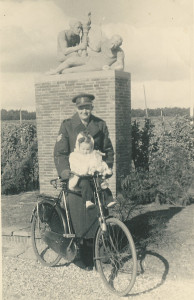
The Dutch word vader means 'father.' Finding fathers can be difficult if the parents weren't married. Some tips: Check the birth record to see if the margin has any notes about the child being recognized by a father later in life. This need not be the biological father but it can be a good clue. Check population registers (since 1850) to see whom the mother was living with. Check church council minutes to see if the mother was censored. Do an autosomal DNA test. This is particularly … [Read more...]
Dutch term – Pinksteren
9 June 2014 by Leave a Comment
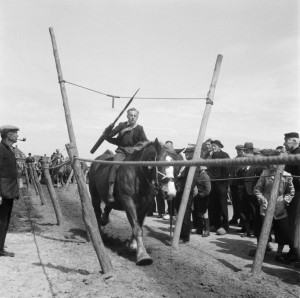
The word 'Pinksteren' is Dutch for Pentacost, a religious holiday. In the Netherlands is it celebrated on Pentacost Sunday and the following day. Pentacost Monday is an official holiday and most of the people in the country have the day off. Nowadays, many people take the opportunity to go to a music festival, go to the beach or attend some traditional fairs. In earlier times, Pinksteren was a typical time when people became confessed members of the Dutch reformed church, together with … [Read more...]
Dutch term – Zomermaand
2 June 2014 by Leave a Comment
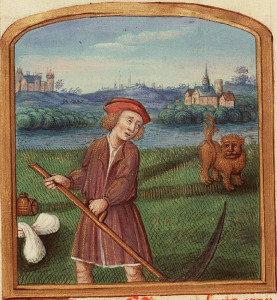
Zomermaand literally means "Summer month" and is the old word for June. … [Read more...]
Dutch term: Memorie van Successie
27 May 2014 by Leave a Comment
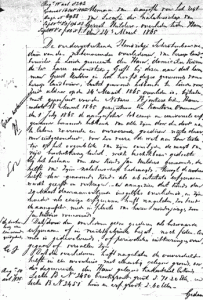
A Memorie van Successie (literally: memorial of succession) is a death duties file. To determine the inheritance tax due after a person died, the heirs had to file a Memorie van Successie. Read more about Death Duties Files and how to use them for your research. … [Read more...]
Dutch term: Molenaar
20 May 2014 by Leave a Comment
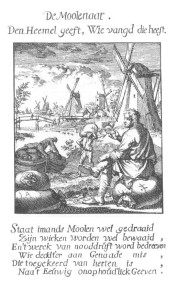
A molenaar was a miller. There were different types of mills. Besides the classic Dutch wind-powered mill, there were also horse-drawn mills and water mills. Mills could be used for different purposes, the most common being grind grain or to drain water from low-lying fields. People could not just build a mill, that right was reserved for the landlord. Before the 19th century, most millers did not own the mills that they worked, but worked for the landlord. The French occupation put an end to … [Read more...]