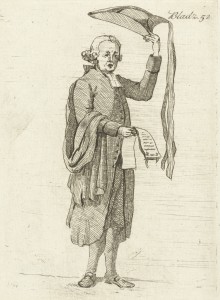
Naastingsrecht was the right to have the first option of buying a property. Whenever a property was sold, a person who had naastingsrecht could match the purchase price and buy the property for himself, cancelling the original sale. Different parts of the Netherlands had different variations of this right. In most regions, next of kin had naastingsrecht. For instance, a younger brother could prevent his older brother from selling the family farm to a stranger by buying it himself. … [Read more...]
What spouses promised each other
20 February 2015 by 4 Comments
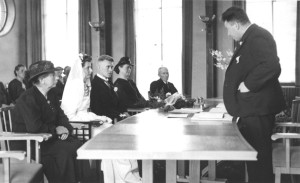
If you have ever read all of the text of an early civil registration marriage record, you may have read how the groom and the bride promised to fulfill the duties of a husband and wife towards each other as specified in Title 5, Chapter 6 of the Civil Code. So what does that actually mean? Here is what the law of 1823 says about that. Of the rights and duties of the spouses to each other The spouses owe each other, each to the other, faithfulness, aid and support. The husband owes his … [Read more...]
Quick tip – Not many Dutch DNA cousins
18 February 2015 by 22 Comments
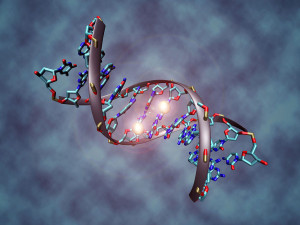
When you take a DNA-test for genealogical purposes, don't be surprised if you don't find many Dutch matches. Because DNA testing isn't very popular in the Netherlands, there will be few Dutch people in the databases. So not finding many Dutch matches doesn't mean that your paper trail that shows a Dutch ancestor is wrong. Why DNA testing isn't popular in the Netherlands I think there are several reasons for this: Many people are unaware of the possibilities that DNA can offer. If they … [Read more...]
Dutch term – Weesmeester
16 February 2015 by Leave a Comment
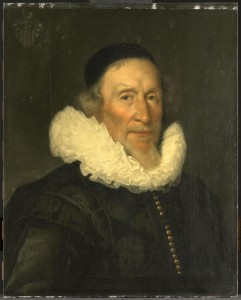
A weesmeester was a government official charged with overseeing the administration of the estates of orphans. They were usually appointed by the city government. Weesmeesters worked for the Weeskamer. Read the article about Weeskamers for more information. … [Read more...]
What is your earliest Dutch family photograph?
13 February 2015 by 11 Comments
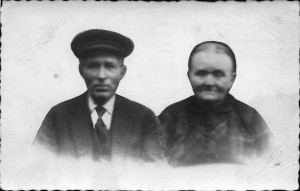
In the Netherlands, photography took off much later than in countries like the US or the UK. As a result, many of us only have family photographs going back to the early 1900s. So I was wondering, what is your earliest photograph? Please leave a link in the comments or post the image to the comments on this article on Facebook. Great-great-great-grandparents The earliest photograph I have of any of my ancestors is a picture of Arend Kastein (1817-1903) and Dora Buitink (1824-1899). Arend was a … [Read more...]
Quick tip – Your ancestors may have gotten older than you think
11 February 2015 by 1 Comment
Many people think that people died a lot younger in earlier centuries. While poor healthcare, contagious diseases, risks of childbirth and dangers at sea certainly took many of our ancestors before their time, several of them lived to be quite old. The main reason that the average lifespan was shorter than today is because of infant mortality. But none of our ancestors died as a child: all of them lived long enough to produce offspring or they would not have been our ancestors. Their … [Read more...]
Dutch term – slager
9 February 2015 by 5 Comments
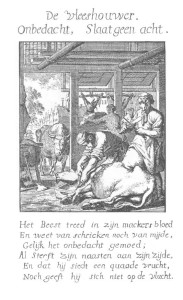
A slager is a butcher. An old term for slager is 'vleeshouwer' or 'vleeschhouwer' (literally: meat cleaver). Poor people did not often eat meat. One of the recurring themes in letters written by emigrants to the United States is their surprise that everyone is able to afford eating meat. These 'spekbrieven' [bacon letters] are one of the reasons why many relatives chose to follow them. … [Read more...]
Twisted family relationships in Nijmegen
6 February 2015 by 7 Comments
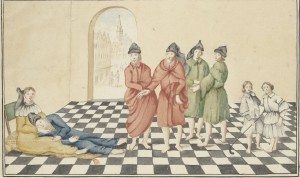
In the 17th century, a genealogical riddle was published in Nijmegen. The Nijmegen riddle A painting hangs in the Nijmegen Town Hall showing a young woman with an old man lying in her lap, with six sons standing next to her: two in red, two in green and two in white. The wife of the old man speaks: "Remark and see that I declare The two in red are my father's brothers. The two in green are my mother's brothers. The two in white are my children and I, the mother, am married to the … [Read more...]
Quick tip: Reading Dutch handwriting (video)
4 February 2015 by 1 Comment
Familysearch has three free videos that teach you the basics about reading Dutch handwriting: Reading Dutch Handwritten Records Lesson 1: The Dutch Alphabet Reading Dutch Handwritten Records Lesson 2: Dutch Words and Dates Reading Dutch Handwritten Records Lesson 3: Reading Dutch Records … [Read more...]
Dutch term – Poorter
2 February 2015 by 2 Comments
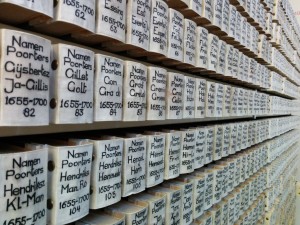
A poorter was a burgher or freeman of a chartered town. Being a poorter conveyed several privileges: Guild membership was often limited to poorters Poorters often were exempt from paying tolls Being a poorter was a requirement for many public offices People could become poorters by being born to a poorter, by marrying a poorter's daughter or by paying a fee. For some cities, the poorterboeken [burgher books] for people who paid to become poorters have survived and can give information … [Read more...]