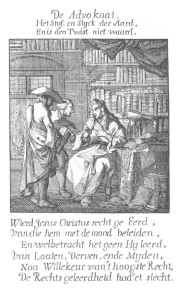
An advocaat is a lawyer. I am often surprised at the number of court cases my ancestors were involved in. Even some of my serf ancestors hired lawyers to defend their rights to cutting trees or taking over the farm against the landlord. Most lawyers would have had a university education. Since 1575, Leiden had a university where people could get a law degree. Other universities followed later. You will recognize these academically trained lawyers by the letters "J.U.D." behind their names … [Read more...]
The Josh Groban episode – the Dutch part
16 March 2015 by 31 Comments
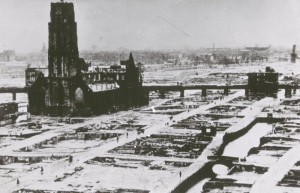
A couple of months ago, I was asked by the producers of the US version of Who Do You Think You Are? to help with the final leg of Josh Groban's journey to uncover the story of his ancestor Johann Jacob Zimmermann. They had found out in Germany that Zimmermann came to Rotterdam, the Netherlands, on his way to Pennsylvania, and died around the time of departure in August or September 1693. Could I please help find out where he was buried? Wait, let me think. You betcha! Searching for the … [Read more...]
Column – The right to be forgotten
13 March 2015 by 1 Comment
A new European guideline ensures that citizens have the right to be forgotten. They can ask search engines to remove results that are no longer relevant. That will prevent your drunk selfie from appearing on the first page of search results the next time a potential employer searches for your name. The guideline is primarily aimed at search engines, but wider regulation is in the works. As genealogists, we're used to personal information becoming public after enough time passes, even if the … [Read more...]
Quick tip – Check the margins of a record
11 March 2015 by 1 Comment
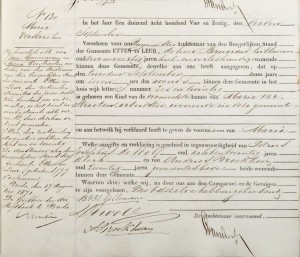
If you consult an original record, make sure to check the margins for any notes. For example, the margins of a birth record may tell you that an illegitimate child was later acknowledged by a man who married the mother. The margins may also contain corrections of the main text, for example if an error was made. These corrections can be made at the time of creation, but can also be ordered by the court many years later, for example if a mistake in the gender or name of a child was only … [Read more...]
Dutch term – Schoolmeester
9 March 2015 by 1 Comment
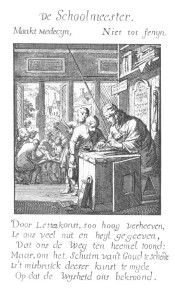
A schoolmeester is a school teacher. Most school teachers taught in small village schools, consisting of one room, where they were expected to teach reading, writing and arithmetic to their pupils. Reading was considered more important than writing, as they could then read the bible. Most children would only go to school for about six years. Children of farmers would be kept home in the summer to help with the harvest and in the winter they would not always be able to attend school if the … [Read more...]
Ask Yvette – Are there any records of people who helped Jews in World War II?
6 March 2015 by 5 Comments

Earlier this week, Kirk Payne wrote the following comment: I have a request that might stump you. My wife’s immediate ancestors immigrated to the US in the early 20th Century. Most of her great- and great-great Aunts and Uncles remained in the Netherlands. She had a cousin ask us if we’d seen any records showing her relatives having helped the Jews in the Netherlands during and preceding WWII. … [Read more...]
Quick tip – Population registers are like movies
4 March 2015 by Leave a Comment
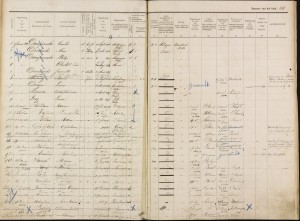
Population registers can be difficult to understand, because one page can have information about people at different times. This can be especially confusing for people who are used to dealing with census records. Here's an analogy that might help you: Census records are like snapshots, population registers are like movies. Population registers record what is going on with a family over a period of time, usually about ten years. By reading the lines from top to bottom, you will see who … [Read more...]
Dutch term – Geslacht
2 March 2015 by Leave a Comment
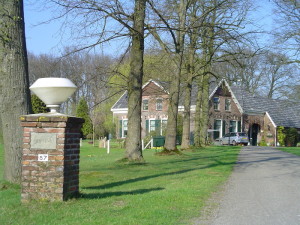
The word geslacht has two meanings: Gender/sex. "Man" or "mannelijk" is male "Vrouw" or "vrouwelijk" is female "Beide" is both "Onbekend" is unknown. Family/house ("Het geslacht Hoitink" = the house of Hoitink). This meaning of geslacht is slightly archaic, a more contemporary way to say this would be "De familie Hoitink" [the Hoitink family]. … [Read more...]
Source – Prison Records
27 February 2015 by 14 Comments

Ironically, it's often the black sheep that bring the most color to our family trees. I love researching all the stories in my family, and prison records are a wonderful resource. History Before the French occupation (1795-1813), people were rarely imprisoned. Instead, criminals were hanged, banished, put in the pillory or sent to the work house. The modern system of prisons was introduced in 1811. In the 19th century, people were much more likely to be send to prison than today. Today, you … [Read more...]
Quick tip – Check your photos. Again.
25 February 2015 by 3 Comments
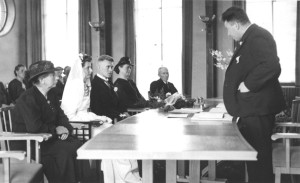
Last week, I wrote a post about What spouses promised each other, in which I used a photograph of my grandparents' wedding. When browsing my Facebook feed, the story came up and I looked at the photo just like I would at any other photo. And there he was. My great-great-grandfather. Next to my grandfather sits his mother. Then, an empty seat, where his father should have been (he died six months before the marriage). But the next chair is occupied by an elderly man. Who else could … [Read more...]