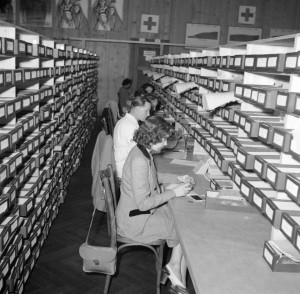
An Archiefvormer is the creator of an archive. Examples of archiefvormers are municipalities, churches, societies, foundations and private persons. Thinking about which archiefvormers your ancestor may have been in contact with is a great way to discover unknown records. Read the article Find your ancestors by understanding how records are created for more information. If you check the finding aid (inventaris), you can see who the archiefvormer was. Most online finding aids will allow you … [Read more...]
Review – Atlas De Wit: City Atlas of the Low Countries
10 April 2015 by Leave a Comment
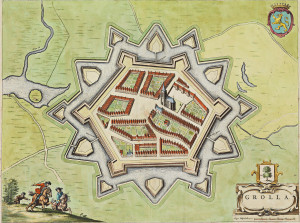
Last year, I won a wonderful facsimile atlas in a contest by the Royal Library. I love maps and am a founding member of the study group for the history of cartography in my home town. When I saw that the Royal Library was giving away a copy of this atlas for the best tip on how to get the most out of their newspaper website Delpher, I did my best to submit an outside-the-box kind of tip to maximize my chances of winning and it worked :-) My tip? Search for common OCR errors. I really enjoy … [Read more...]
Quick tip – Search for common OCR errors
8 April 2015 by 2 Comments
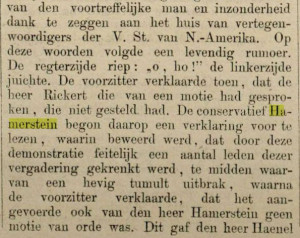
As genealogists, we often search pictures of texts, for example when we use newspaper websites like Delpher. Often, automatic character recognition techniques (OCR) have been used to convert the images to searchable text. These techniques aren't perfect, especially with poor quality ink, old fonts or digitized microfilms. The mistakes that OCR techniques make are somewhat predictable: an m gets recognized as rn, an e as a c, and an l as a 1. By searching for the versions with and without a … [Read more...]
Dutch term – Pasen
5 April 2015 by Leave a Comment
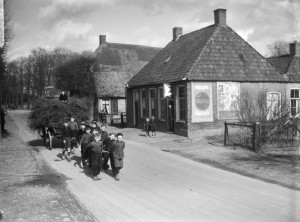
Pasen is the Dutch term for Easter. In the Netherlands, Easter Sunday and Easter Monday are official holidays and most people have the day off. Most of the Easter traditions that are celebrated in the Netherlands are pretty universal, like painting and hiding eggs. In the eastern part of the country there is a more unusual tradition: Easter fires (Paasvuren). For weeks before Easter, people will be busy collecting wood to create a high pile. This is then lit on Easter Sunday or Monday. The … [Read more...]
Quick tip – Not many records on passengers passing through Rotterdam
3 April 2015 by 3 Comments
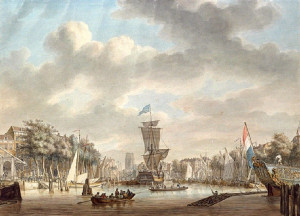
If you've been watching Who Do You Think You Are? in the US, you may have noticed that both Josh Groban and Angie Harmon had ancestors who left Europe via Rotterdam. Rotterdam has been one of the most important harbors in the world for centuries. Since the 17th century, it has been the final port of departure for millions of emigrants. These people came from all over western Europe. Many people ask me if I can find records about their ancestors who left via Rotterdam. Unfortunately, most … [Read more...]
April Fools’ Day in the Netherlands
1 April 2015 by 2 Comments

April Fools' Day is celebrated in the Netherlands. The first recorded April Fools' joke in Dutch dates to about 1560, when a poem mentioned how a servant recognized a prank that his master was trying to pull on him.1 The best April Fools' joke that I've seen up close was when I was studying at the University of Twente. The nearby Grolsch brewery had an ad in the paper for a trial with a beer pipeline directly to student housing on campus, which would be more efficient than the trucks full of … [Read more...]
Dutch term – Achterneef
30 March 2015 by Leave a Comment
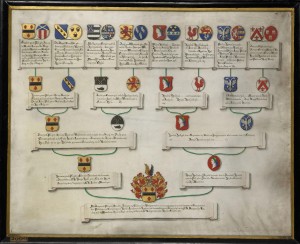
An achterneef (literally: behind cousin) is a male relative. The term covers the English terms great-nephew, first cousin once removed and second cousin. … [Read more...]
The illegitimate, doubly baptized, incestuous orphan
27 March 2015 by 6 Comments
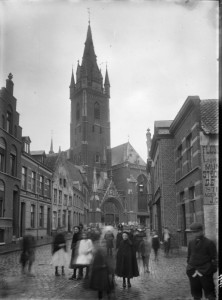
Sometimes you read records and you wonder how much bad luck one person can handle. While doing research for a client I came across the following baptism in a transcription of the Roman-Catholic baptismal records for Venlo in 1750-1760:1 1751 13 november Anna Elisabetha conditionaliter rebaptizata est filia spuria Andreae Ketels et Gertrudis Podor qui sunt consanguinei in secundo consanguinitatis gradu: susce- perunt Jacobus Podor et Anna Elisabetha van Cauwenbergh As all Roman … [Read more...]
Quick tip – The meaning of terms changed
25 March 2015 by 4 Comments
Over time, the meaning of terms could change. For example, the term stiefvader [stepfather] now means the husband of your mother. But in past times, the word would be used for any type of father-by-marriage, including the father of the wife (now called schoonvader or father-in-law). To fully understand the meaning of a record, it is important to understand the meaning of all the terms at the time the record was created. … [Read more...]
Dutch term – Begraven
23 March 2015 by Leave a Comment
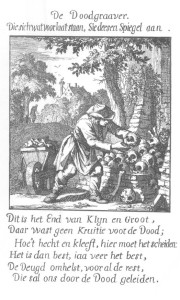
Begraven means to bury. People were usually buried two to five days after they died, sooner if there was an epidemic. Burials were recorded in the Begraafboek (burial book). … [Read more...]