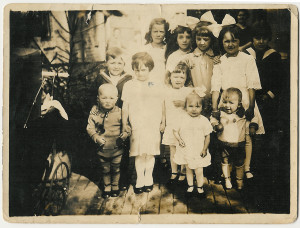
Because Dutch children were often named after their grandparents, it is not unusual to find several first cousins with the same name, all named after the same grandparent. Often, these same-named cousins will be of a similar age, which can make it easy to confuse the two (or three, or even more!). When you are trying to identify someone, always try to find a document that list the person with his spouse and parents, for example in a marriage record or death record. That will tell you which … [Read more...]
Dutch term – Dodenherdenking
4 May 2015 by Leave a Comment
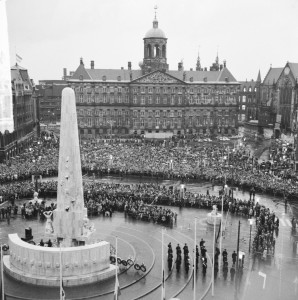
Dodenherdenking means commemoration of the dead. On May 4th, we commemorate all the war victims since the outbreak of World War II. The next day, on May 5th, we celebrate our liberty. The dates are chosen because 5 May 1945 was the day of the German capitulation, which ended World War II in the Netherlands. On Dodenherdenking, the whole country respects a two-minute silence at 8 PM. Commemorations are organized through out the country, where wreaths are laid at war monuments and other places … [Read more...]
Finding collaborators in World War II
1 May 2015 by 6 Comments
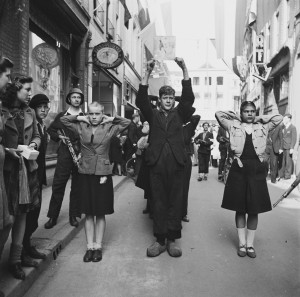
With the 70th anniversary of our liberation coming up next week, I thought I would discuss one of the most important record groups for research into World War II. During World War II, several Dutch citizens collaborated with the German occupation: some joined the National Socialist Movement (NSB), others betrayed Jews or were romantically involved with German soldiers. After the War was over, hundreds of thousands of Dutch citizens were prosecuted for collaboration or treason. If convicted, … [Read more...]
Quick tip – No middle names
29 April 2015 by 9 Comments
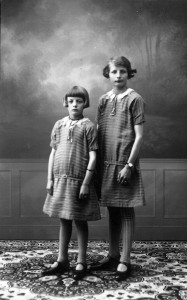
People in the Netherlands did not have 'middle' names. They could have one or more first names, followed by their last name. But even if they had two first names, they would be considered two first names and not a first and a middle name. Before say 1700, most people had just one first name. Afterwards, giving a child multiple first names became popular in some regions. In Catholic families, you can sometimes see a whole string of first names, like "Cornelia Adriana Maria." In some regions … [Read more...]
Dutch term – Kerk
27 April 2015 by Leave a Comment
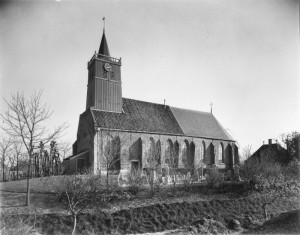
A kerk is a church. Before 1811, the records that the churches kept of baptisms, marriages and burials are the main sources for vital events. … [Read more...]
Ask Yvette – Does my family have a coat of arms?
24 April 2015 by 13 Comments
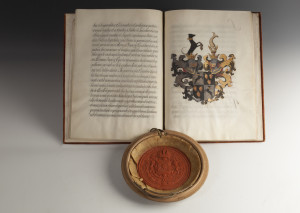
Several people have contacted me wanting to know if they have a coat of arms or family crest. Please keep in mind that the following applies to the situation in the Netherlands; other countries have different rules and uses of coats of arms. Four things to know about coats of arms Most people did not have coats of arms. Most people who used coats of arms, were well-to-do. Often they were nobles, rich merchants (patricians) or administrators. If your ancestor was a poor farmer, chances are … [Read more...]
Quick tip – Use Street View to ‘visit’ your ancestor’s home town
22 April 2015 by 5 Comments
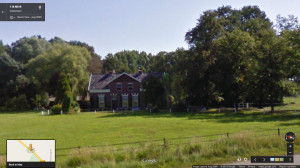
Google Street View has been all over the Netherlands, so you can use this service to make a virtual visit to your ancestor's home town. To use Google Street View, look up the address or name of the town in Google Maps and then click "Street view" or drag the yellow man unto the map. … [Read more...]
Dutch term – Oorkonde
20 April 2015 by Leave a Comment
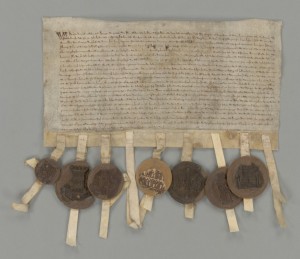
An oorkonde is a charter; a record with seals hanging from the bottom. In the Middle Ages, most transactions went unrecorded, but the ones that were, were recorded in charters. Oorkondes are usually written on vellum or parchment, made from animal skin. With the invention of paper made from rags, charters went out of style although they continued to be used for special occasions, like nobility titles are records of abdication. You can find medieval charters in the archives of old towns … [Read more...]
Five reasons why it’s awesome to have Dutch ancestors
17 April 2015 by 2 Comments
Do you have Dutch ancestors? Congratulations! Here are five things that are awesome about having Dutch ancestors. 1. Dutch records are excellent Since 1850, the government did not just keep census records, they kept them up to date so they always know who's living where. These are called population registers. Civil registration of birth, marriages and deaths was introduced in 1811 (or even earlier in some southern parts of the country). Church records of baptisms, marriages and … [Read more...]
Quick tip – Free Dutch language course
15 April 2015 by Leave a Comment
Have you always wanted to learn Dutch? The University of Groningen is teaching a free online course that will teach you the basics of the language in three weeks. The next course starts 1 June 2015. Read more information about the Dutch language course on the Future Learn website. … [Read more...]