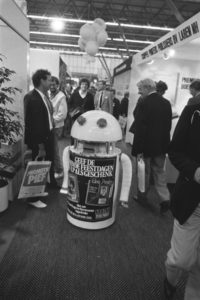
For years, we've heard about arm chair genealogists; researchers who do their family trees from home without going to repositories. The suggestion that this can't be a good researcher is no longer valid, considering the wide variety of sources that are available online. New is the robot genealogist, a computer program that analyzes sources and draws its own conclusions. The hints that genealogy programs and websites give about possibly relevant sources can be seen as a first incarnation of … [Read more...]
Quick tip – Hiding under another name
25 July 2018 by 1 Comment
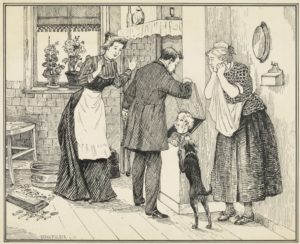
If your ancestors were from a small town and you can't find their parents, perhaps they're hiding under another name. There wasn't a great influx of new people in a small town, so don't automatically assume that people came from elsewhere if you can't find them. They could be hiding under a different farm name, or their last name could be a patronymic referring to the first name rather than the last name of the father. Or maybe they were the first in their family to use that particular name … [Read more...]
Was Eleanor of Aquitaine my Ancestor? Generation 8 – Hendrik Smulders
20 July 2018 by 6 Comments
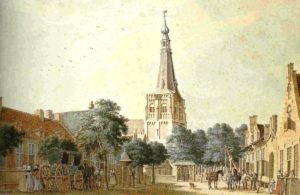
This is the ninth post in a series about my possible line of descent from Eleanor of Aquitaine. In the first post, I explained how I discovered the possible line, and how I am going to verify it one generation at a time. In the last post, I proved that my fourth great-grandfather Laurens Smulders was the son of Hendrik Smulders. Hendrik Smulders, son of Jan Smulders In the last blog post, I briefly discussed the marriage and death record of Hendrik Smulders, who married in 1777 and died in … [Read more...]
Dutch term – Fries
16 July 2018 by 3 Comments
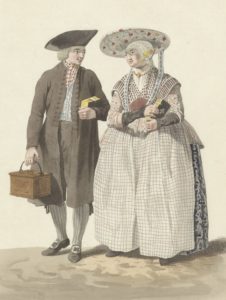
Fries means Frisian; from Friesland. The word is used as a noun to indicate a person from Friesland, or as an adjective for all things Frisian. For research in Friesland, try AlleFriezen, a website with many indexes and scans of Friesland records. BTW, in English, "Frisian" is used as the general adjective for Fries, while "Friesian" is used for the horses. So don't call someone a Friesian unless it's a horse. … [Read more...]
What Dutch DNA Looks Like – 2018 edition
13 July 2018 by 51 Comments
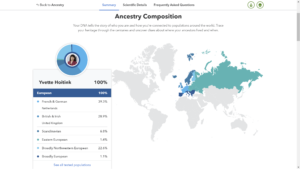
In 2016, I wrote a blog post comparing the ethnicity predictions between the three largest providers of DNA tests. Since then, some companies have changed their algorithms and I've tested with two more companies. Time for an update! I've kept the original article as-is so we can compare how the predictions change over time. To recap, according to my tree, I'm mostly Dutch with a bit of German. DNA matches confirm that my tree is correct for the past several generations. I have some French … [Read more...]
Dutch term – Zaterdag
7 July 2018 by Leave a Comment
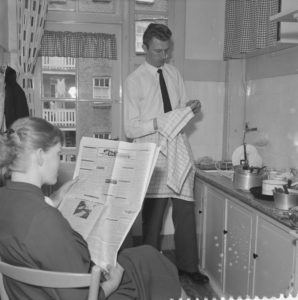
Zaterdag is the Dutch word for Saturday. In the early to mid 1900s, Saturday was a work day for men and a half school day for children. It wasn't until the 1960s that the five-day work week became common. … [Read more...]
Dutch Genealogy News for June 2018
6 July 2018 by 1 Comment
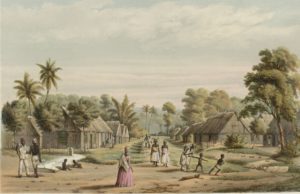
Here is an overview of the new sources, projects, and news about archives that were announced last month. Online sources An index and scans of the slave registers of Suriname from 1851-1863 were published at GahetNA. The index and scans from the period 1830-1851 will follow later this year. The website GenealogieDomein published several transcribed tax records from 1763 of different places in East-Gelderland. Scans of the notarial records of Haarlem from 1573 to 1842 were published … [Read more...]
Quick tip – The Legal Father May Not Have Been the Biological Father
4 July 2018 by 6 Comments
If a child is born out of wedlock, it is possible he or she was later legitimized when the mother married. Legally, the mother's husband would then be the father. But that doesn't mean he was the biological father. In these situations, there are several things you can do to verify if the legal father was also the biological father: You can compare timelines of the mother and the legal father to see if they were in the same place around the time of conception. You can research the … [Read more...]
Ask Yvette – How to Record Place Names
29 June 2018 by 2 Comments
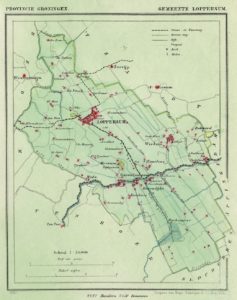
Dutch Genealogy reader Linda had the following question: In my research, the locations for some births/deaths, etc. are confusing. I'm finding, "Lellens, Ten Boer, Groningen, Netherlands" or just "Ten Boer, Groningen, Netherlands". ALSO "Stedum, Loppersum, Groningen, Netherlands" or just "Loppersum, Groningen, Netherlands", and once, "Stedum, Groningen, Netherlands." Could you please address the correct way to list the locations of births/marriages/deaths? Ten Boer, Loppersum, and Lellens … [Read more...]
Dutch term – Nageslacht
25 June 2018 by 1 Comment
The Dutch term nageslacht means offspring or progeny; the descendants of a person. … [Read more...]