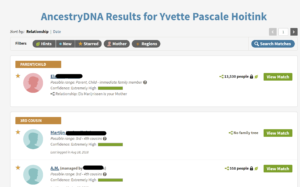
Last month, I blogged about my ethnicity predictions, which were wildly off. As a result, several people have asked me: Should I take a DNA test if they are so unreliable? My answer? Absolutely! You see, a DNA test gives you two types of results. On the one hand, it gives you the ethnicity predictions. This feature has the most curb appeal and is a reason why many people test. Unfortunately, these results are highly speculative, especially below the continent level. My ethnicity … [Read more...]
Dutch term – Trein
27 August 2018 by 2 Comments
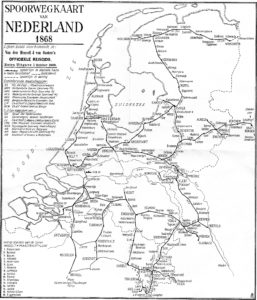
A trein is a train. The first railroad in the Netherlands was opened in 1839, between Amsterdam and Haarlem. Other railroads quickly followed and by the end of the 1800s, passenger travel by rail had supplanted travel by barge. Many emigrants leaving through the ports of Rotterdam, Amsterdam, or Antwerp took the train to the harbor. … [Read more...]
Four Degrees of Separation
24 August 2018 by 7 Comments
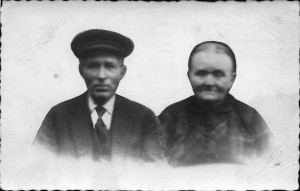
Randy Seaver offered the following Saturday Night Genealogy Fun challenge: Using your ancestral lines, how far back in time can you go with FOUR degrees of separation? That means "you knew an ancestor, who knew another ancestor, who knew another ancestor, who knew another ancestor." When was that fourth ancestor born? Here is my line: I knew my paternal grandfather, Hendrik Hoitink (1914-2000). He knew his maternal grandmother, Johanna Piek (1860-1930). She would have known her … [Read more...]
Quick tip – Dates in Population Registers May Be Incorrect
22 August 2018 by Leave a Comment
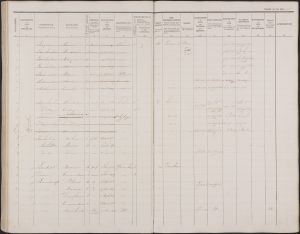
If you're using population registers, keep in mind that these registers were often copied from older registers and may contain copy errors. The birth dates mentioned in them were often not written close to the time of birth, and the informants may have made mistakes. If you find a birth date in a population register, always verify that information using other records. More reliable sources for birth dates are birth records or baptismal records that were created shortly after the birth, with … [Read more...]
Was Eleanor of Aquitaine my Ancestor? Generation 9 – Jan Smulders
17 August 2018 by 6 Comments
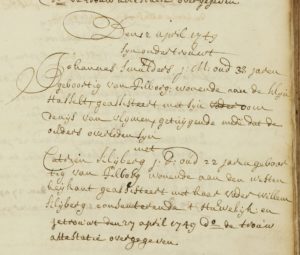
This is the tenth post in a series about my possible line of descent from Eleanor of Aquitaine. In the first post, I explained how I discovered the possible line, and how I am going to verify it one generation at a time. In the last post, I proved that my fifth great-grandfather Hendrik Smulders was the son of Jan Smulders and Catharina Cleijberg. Jan Smulders, son of Petronella van Vlijmen Research into Jan's son Hendrik had already uncovered the marriage record of Jan Smulders and Catharina … [Read more...]
Dutch term – Alhier
13 August 2018 by 2 Comments
Alhier means in this location, meaning the place where the record was created. You can often encounter the term in marriage records, where the bride and groom were from alhier. … [Read more...]
Dutch Genealogy News for July 2018
10 August 2018 by Leave a Comment
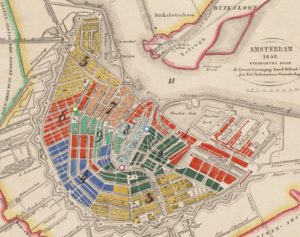
Here is an overview of the new sources, projects, and news about archives that were announced last month. Online sources ZoekAkten, the website that provided easy waypoints to the Dutch records at FamilySearch, has been taken offline. The volunteer behind the website decided to pull the plug. The records themselves can still be found via the Netherlands page or via the Catalog at FamilySearch. Volunteers have indexed the "Oost-Indisch Boek," the military service records for soldiers in … [Read more...]
Quick tip – Last Name or Patronymic?
8 August 2018 by 2 Comments
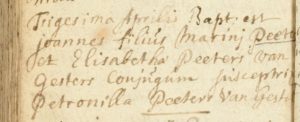
If you're researching a family with a name like Jansen, Zwiers, or Pieterse, at one point you will find the original person for whom the name was not a hereditary last name but a patronymic derived from the father's name. My mother's name is Marijnissen. As a beginning genealogist, it took me a while to realize that the father of her brick wall ancestor wasn't called Marijnissen but had Marijnis as a first name. I found his father as Marinus Peeters. When dealing with such names before … [Read more...]
Quick tip – Find Reusable Images at the Cultural Heritage Service
1 August 2018 by Leave a Comment
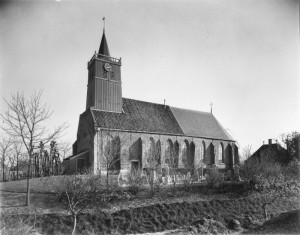
The Rijksdienst voor Cultureel Erfgoed [Cultureel Heritage Service] is a government organization that oversees the care for monuments, archaeology, and museums in the Netherlands. The service has an online image bank with a range of digital images: Photos of monuments and archaeological sites Maps and original indicator tables of the cadastral registration of 1832 Photos of collections of some museums. I often use this image bank to find photos of churches where my ancestors … [Read more...]
Dutch term – Bejaard
30 July 2018 by Leave a Comment
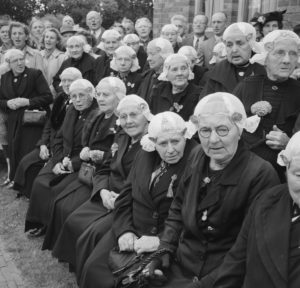
In modern Dutch, the term bejaard means "senior" and a bejaarde is a senior citizen. Before say 1800, the term bejaard or bejaerd was used to indicate that somebody had reached the age of majority. You can encounter the term in marriage records, which may call somebody an onbejaarde man [man who is not of age] or bejaerde dogter [woman/daughter who is of age]. … [Read more...]