In 1659, the famous mapmaker Joan Blaeu published his world atlas Tooneel des Aardrycks [Display of the Realm of Earth]. The archives in Leiden have made their atlas available online. This week we are looking at his map of Overijssel. It shows the IJssel river on the west, which connected the to the North Sea in the north and the Rhine river in the south, bringing prosperity to the area. The area of Twente in the east shows different cities, including Oldenzaal ("Oldenzeel" on the map), where … [Read more...]
About this website
Creating a website like this is a fun activity. There are so many options, so many choices. What do visitors want? What do I want? In this blog I will describe some of the things I encounter in developing and maintaining this website.
Dutch Genealogy News for July 2024
5 July 2024 by 1 Comment

Here is an overview of the new sources, projects, and other news announced in the past month. Sources The Staten van Oorlog [War Rosters] 1595-1795 are now available via the Brabants Historisch Informatie Centrum. These rosters include information about various people who held important positions in the Dutch army, such as officers who led companies, watch commanders, ministers, etc. The rosters provide detailed information about the structure of the army at the level of individual … [Read more...]
Map of the week – Reclaimed land in North Groningen, 1685
1 July 2024 by Leave a Comment

This week's map shows us land that was reclaimed from the sea by building a dike in the north of the province of Groningen. This includes land in the parishes of Hornhuizen, Wierhuizen, Pieterburen, Westernieland, Saaxumhuizen, Den Andel, Breede, Warffum, Usquert, and Uithuizen. The map was created in 1685 and lists all the owners of the land. Maps like this can be a great source of information to learn about property owned by your ancestors. … [Read more...]
Map of the Week – Plan to drain the South Sea, 1891-1892
24 June 2024 by 2 Comments

In 1891, Cornelis Lely came up with a plan to claim more land from the sea. His ambitious plan involved building a dike between North Holland and Friesland to close off the Zuiderzee [South Sea]. That would make it possible to reclaim large sections of land and create a fresh water lake, the IJsselmeer. This plan formed the basis of a major water engineering project carried out in the first half of the 1900s. In 1932, the dike was completed. The southern (Flevopolder) and eastern (Noordoost … [Read more...]
Yvette Hoitink, MLitt!
20 June 2024 by 20 Comments

Today I graduate with a Master of Letters in Family and Local History from the University of Dundee. My grades allowed me to graduate with Distinction, the highest award that the university bestows. I started my studies during lockdown in 2020. I am not one to grow indoor tomatoes or bake sourdough bread, so I went and did a master's instead. This degree was completely via remote study, which made it a perfect choice for me. The Netherlands does not offer academic programs in genealogy, so … [Read more...]
Map of the week – Maastricht, 1585
17 June 2024 by 2 Comments

In 1585, Braun and Hogenberg published an atlas with maps of different cities in Europe, including many in the Netherlands. This map shows Maastricht. What is nice about these maps is that it shows the people in their local costumes. It shows all the houses in the city, and you can see the different expensions. The detail shows the main church in Maastricht, the St. Servaas. The blue color of the roof indicates it is an untaxed building, usually either religious or city buildings. You can see … [Read more...]
Dutch Genealogy News for June 2024
14 June 2024 by Leave a Comment

Here is an overview of the new sources, projects, and websites that were announced last month. Sources Death records of Suriname (1846-1915) have been digitized and indexed and are available on the website of the National Archives of Suriname. The Ward Registers of Paramaribo, Suriname 1828-1847 have been digitized and indexed and are available on the website of the National Archives of Suriname. The ward registers are annual recordings of all the free people living at each address. … [Read more...]
Map of the Week – Goes, 1867
10 June 2024 by Leave a Comment

Between 1865-1868, Jacob Kuyper published a series of atlases with municipal maps. These show the location of all the hamlets, villages, and larger towns in the municipality, as well as the main roads and railroads. The Kuyper maps are often available at the websites of archives or via Wikimedia Commons. This week we are looking at Kuyper's map of Goes, in the province of Zeeland in 1867. It shows that Goes had a railroad connection to Bergen op Zoom and a railway station just south of the … [Read more...]
Map of the Week – Tourist map of Oisterwijk, 1933
3 June 2024 by 2 Comments

This week we are looking at a tourist map of Oisterwijk from 1933. It is a "wandelkaart" [walking map], which highlights various natural features like lakes (blue), forests (green), national forests (orange), swamps (blue horizontal stripes). It features the hotels in the area and places of interest including churches, a swimming pool, and cafes. The early 1900s saw the rise of tourism for the middle and upper classes. Railroads allowed people to travel across the country affordably and … [Read more...]
Quick tip – Identity is more than a name
29 May 2024 by Leave a Comment
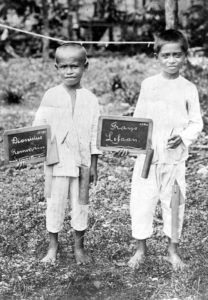
Identity is more than a name. Just because two records show the same name, does not mean they are for the same person. The reverse is true too. Just because two records show a different name, does not mean they are for different persons. People could use different names throughout their lifetime. Some examples: Some people used patronymics and later adopted a surname. They might be listed under their patronymic in one record, and under their surname in another. Some people … [Read more...]