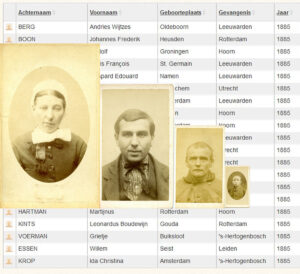
A source with an intriguing name is the "Geheim Register van Ontslagen Gevangen" or the Secret Register of Released Prisoners. This register was kept from 1882 to 1896 and included the photos, personal details, and overview of crimes of the prisoners who would be released in the upcoming month even though they were still considered dangerous. This included people who served multiple sentences, or who served a long sentence for a serious crime. … [Read more...]
Dutch term – Marinier
14 September 2020 by 1 Comment
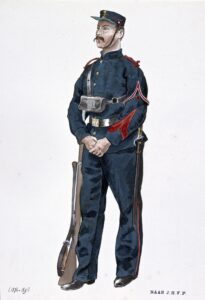
A marinier is a marine. Muster rolls for marines from the period 1813-1940 can be found at the National Archives in The Hague. Some of the records were lost in World War II. The surviving records have been indexed (see "Marine"). See Finding your Maritime Ancestors for more information. … [Read more...]
Dutch term – Armenzorg
7 September 2020 by Leave a Comment
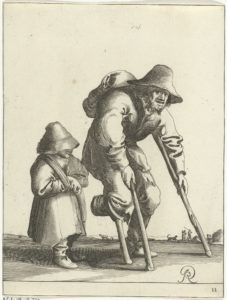
Armenzorg means "care for the poor." You can often find it as a topic in finding aids. See poor relief in the Netherlands in the 1600s for background information about this subject. … [Read more...]
Dutch term – Dominee
17 August 2020 by Leave a Comment
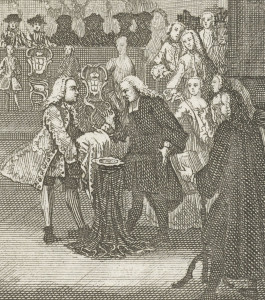
A dominee is a minister, a protestant clergyman. The word comes from the Latin dominus which means "mister" or "lord." Dominees can be found since the reformation in the 1500s. Most of the north-western parts of the Netherlands became Dutch Reformed, while many of the south-eastern parts remained Catholic. Dominees can be found in different types of protestant churches, including Dutch Reformed churches, Christian Reformed churches, Mennonite churches, Anabaptist churches, and remonstrant … [Read more...]
Slave registers of Curacao now available online
17 August 2020 by 5 Comments

The slave registers of Curacao (1839-1863) and the emancipation registers of Curacao (1863) are now available via the website of the National Archives of Curacao and National Archives of the Netherlands. … [Read more...]
Dutch term – Nedersaksisch
3 August 2020 by Leave a Comment
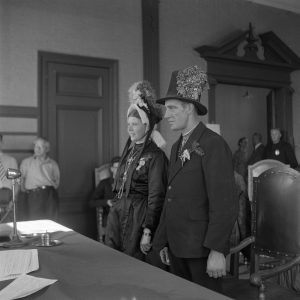
Nedersaksisch is the Dutch word for Low Saxon, a language spoken in the north-east of the Netherlands and across the eastern border in Germany. It has different dialects, including Gronings (in Groningen), Drents (in Drenthe), Twents (east of Overijssel), and Achterhoeks (east of Gelderland). In 1998 it was recognized as an official regional language of the Netherlands, alongside Frisian and Limburgs. Most people who speak Nedersaksisch also speak standard Dutch, though sometimes with an … [Read more...]
Dutch term – Pandemie
27 July 2020 by Leave a Comment
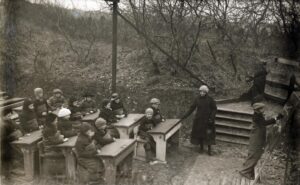
A pandemie is a pandemic. The 1918 Spanish flu pandemic hit the Netherlands pretty hard. About 38,000 people died. The province of Drenthe had the most cases. Here is an image of children going to school outdoors, in the dead of winter in 1918. … [Read more...]
Dutch term – Mannelijke en Vrouwelijke Lijn
13 July 2020 by Leave a Comment
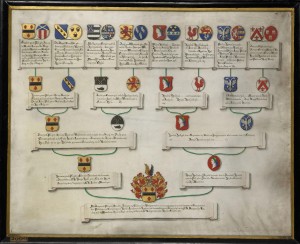
In Dutch, the mannelijke lijn is the male line, and the vrouwelijke lijn is the female line. Traditionally, many Dutch publications have focused on the male line only. Over the past few decades, it has become common to focus on both male and female lines, both in terms of descendants and ancestors. Most Dutch genealogists I know are researching their kwartierstaat, their ancestors in all the lines. People interested in the female line can join Mamamito, a Belgian research project that … [Read more...]
Dutch term – Gevangene
15 June 2020 by Leave a Comment

A gevangene is a prisoner. Imprisonment as punishment became popular in the 1800s, after corporal punishment was largely abolished. For information about prisoners, see Source - Prison records. … [Read more...]
Dutch term – Inwoner and bewoner
8 June 2020 by Leave a Comment

An inwoner is a resident of a location. For example, someone could be an inwoner of Amsterdam, or of the Netherlands. The word does not imply citizenship, just residence. A bewoner is a resident of a building. For example, someone could be a bewoner of a house or nursing home. … [Read more...]