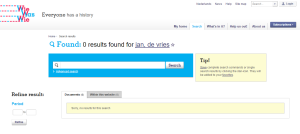
If you are using WieWasWie to search for records about your ancestors, you may have trouble finding them. Here are three of the most common reasons why you have no results when you search in WieWasWie. You fill in too much information WieWasWie only finds records that exactly match everything you search for. Since the introduction of the paid subscription earlier this month, you can't use wildcards or 'begins with' to search for parts of a name, which severely limits your chances of finding … [Read more...]
Quick tip – The Netherlands: Beyond Amsterdam
2 March 2016 by 1 Comment
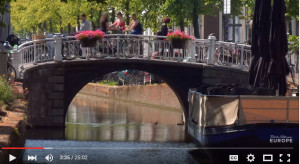
If you want to learn about the history of the Netherlands and our fight against the sea, watch this 25-minute YouTube Video by Rick Steve. The Netherlands: Beyond Amsterdam (YouTube) … [Read more...]
Dutch term – Schrikkeljaar
29 February 2016 by Leave a Comment
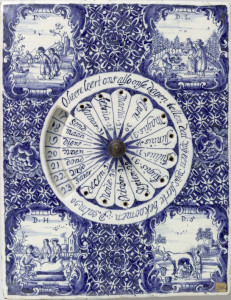
A schrikkeljaar is a leap year. Before 1582, the entire region that is now the Netherlands used the Julian calendar, in which every fourth year is a leap year. Between 1582 and 1700, the different provinces switched to the Gregorian calendar, in which centurial years are not leap years except when they are divisible by 400. This corrected the length of the year by 0.002% compared to the Julian calendar. Read more about the introduction of the Gregorian calendar in a tale of two calendars. … [Read more...]
How Civil Registration Records were Created
26 February 2016 by 2 Comments
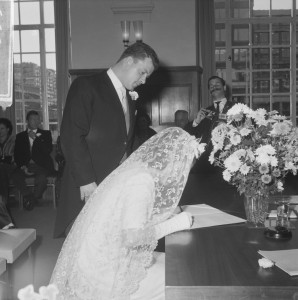
If you are researching nineteenth and twentieth century Dutch ancestors, the civil registration records of births, marriages and deaths are among the first sources you should consult. Understanding how these records were created will help you assess their reliability. Birth records When the civil registration was introduced nation-wide in 1811, the law required that baby be presented at town hall, to make sure that a birth actually took place. Since this could be dangerous to the child, … [Read more...]
Quick tip – Was that last name a patronymic?
24 February 2016 by 3 Comments
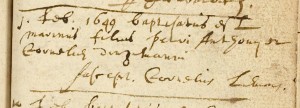
If the last name of your ancestor ends in -s, -se, -sen, or -en, it could originally have been a patronymic; a name derived from the name of the father. Common examples are Jansen [son of Jan], Pieters [son of Pieter] or Cornelissen [son of Cornelis]. Other names are more difficult to recognize as a patronymic, such as "Flooren" [son of Floris], "Dielen" [son of Egidius], or Celen [son of Marcel]. Patronymics were common in most parts of the Netherlands. In the northern provinces, most people … [Read more...]
Dutch term – Gewicht
22 February 2016 by Leave a Comment
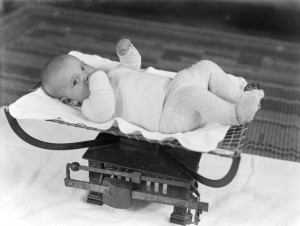
Gewicht is the Dutch term for weight. Since 1811, the Netherlands has adopted the metric system of kilograms. Before that, every region had their own weights. The Meertens Institute has a database of old measures and weights that can help to figure out just how much a pound weighed in a certain time and place. … [Read more...]
Visiting the Family History Library in Salt Lake City
19 February 2016 by 4 Comments
Last month, I had the opportunity to visit the Family History Library in Salt Lake City while I was there for an institute and board meeting. What a special place. I can't believe how many people I met, all so generous and wonderful. I had never met any of them in person before but I had known many of them online for several years (or several decades, as in the case of Cyndi Ingles of Cyndi's List) so it felt more like a high school reunion than a first meeting. And what a fun reunion it was, … [Read more...]
Quick tip – Do the names of the children match?
17 February 2016 by Leave a Comment
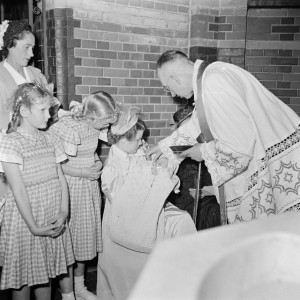
In the Netherlands, children were often named after family members. When you have a theory about who the parents were, make sure to check for repetition of names. If the names of the children of your brick wall ancestor do not appear in the family you think he belongs to, you may have the wrong family. Read more about naming traditions. … [Read more...]
Dutch term – Archivaris
15 February 2016 by Leave a Comment
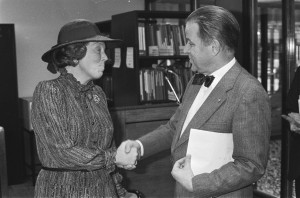
An archivaris is an archivist. In the Netherlands, archivarissen have a college or university degree in archival science; usually after first completing a related degree in history. Every level of government (municipality, province, nation) is required to transfer their older records to an archive which is headed by an archivist. Smaller municipalities often don't have their own municipal archivist but work together in larger Regional Historical Centers. Here are five things I learned from … [Read more...]
Finished my portfolio for the Board for Certification of Genealogists
12 February 2016 by 11 Comments
I did it! I finished and submitted my portfolio for the Board for Certification of Genealogists (BCG). BCG is an international organization that certifies genealogists whose work meets standards. They do this by judging a portfolio consisting of the following elements: Genealogists' Code, signed by the applicant. Many of these items are similar to the Code of Ethics of the Association of Professional Genealogists, of which I am also a member. Background Résumé, which includes … [Read more...]