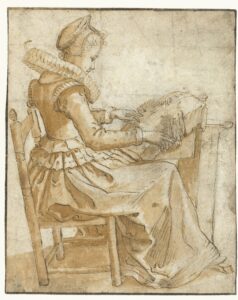
Kantklossen is the art of making bobbin lace. It is made by twisting threads using bobbins. Pins hold the lace in place while it is being made. Bobbin lace took a lot of time to create and was expensive. Having clothes with bobbin lace was a sign of wealth and can be seen in many paintings and inventories of richer people. … [Read more...]
Ask Yvette – How to Organize Files for Dutch Ancestors
31 May 2019 by 19 Comments
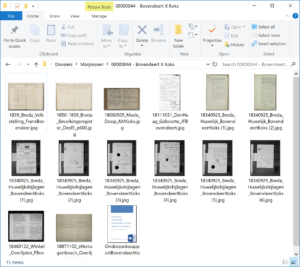
A reader was used to organizing her files by last name. Before 1811 her Dutch ancestors did not have last names but used patronymics, which made it difficult to see which files belonged to which line. She asked me how to organize files for people who did not use last names. I thought it might be helpful to share how I organize my files. I will use the files of my mother's side as an example. I have two trees, one for my father and one for my mother. Most people prefer to have only one tree, … [Read more...]
Quick tip – Cadastral records don’t always show the current owner
29 May 2019 by Leave a Comment
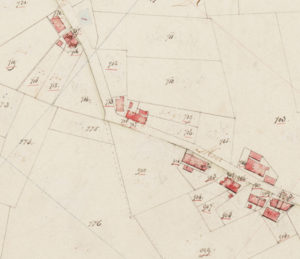
In cadastral records, you may encounter the situation where your ancestor appears as owner of real estate long after his death. This happens if the estate remains undivided, for example if there is a surviving spouse. Sometimes, the cadastral records are corrected to show the heirs, but sometimes the deceased owner remains on the books. See the article about Laurens Smulders for an example. … [Read more...]
Quick tip: Find magazines and journals on Delpher
22 May 2019 by Leave a Comment
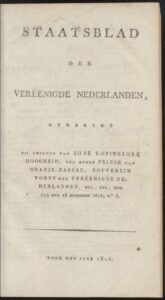
Many out-of-copyright magazines have been scanned and are available via Delpher. Delpher has digitized over 5.7 million pages from 470 magazines since the 1800s. Some categories are: Government publications, such as the Staatsblad van het Koningrijk der Nederlanden [National journal of the Kingdom of the Netherlands], where new laws and regulations are published. Professional journals, just as Nieuwe bijdragen ter bevordering van het onderwijs en de opvoeding [new attributions for the … [Read more...]
Dutch term – Kwartierherhaling
20 May 2019 by 1 Comment
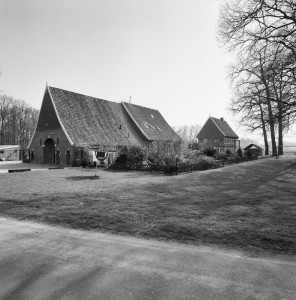
Kwartierherhaling, literally "repetition of quarters," means pedigree collapse: the situation where the same people appear in multiple places in your pedigree chart. That means you descend from the same person or couple in different ways. If your ancestors are from small towns in the Netherlands, sooner or later you'll run into kwartierherhaling. In general, the more recently your ancestor lived in a small village, the higher the collapse. On my father's side, who was from the village of … [Read more...]
Was Eleanor of Aquitaine my Ancestor? Generation 18 – Johanna van Wijfliet
17 May 2019 by 7 Comments
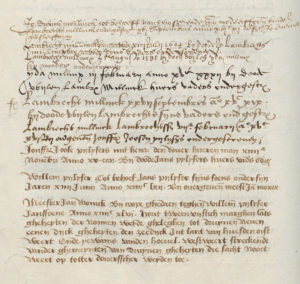
This is the nineteenth post in a series about my possible line of descent from Eleanor of Aquitaine. In the first post, I explained how I discovered the possible line, and how I am going to verify it one generation at a time. In the last post, I proved that my fourteenth great-grandmother Barbara Willems Pijlijser was the daughter of Willem Jans Pijlijser and Johanna van Wijfliet. Johanna van Wijfliet, daughter of Willem van Wijfliet Research into Barbara Willems Pijlijser turned up several … [Read more...]
Quick tip – Use the Dutch Genealogy Search function
15 May 2019 by Leave a Comment

Do you have a question about Dutch Genealogy? This website contains almost a thousand articles about Dutch sources, terms, and research strategies. Try searching for your term in the search box in the top right corner of the website. Examples: English versions of Dutch first names Using search engines How to find my immigrant ancestor in the Netherlands How to find the father of an illegitimate child How to capitalize Dutch names with prefixes Cheat sheet for records after … [Read more...]
Dutch Genealogy News for April 2019
10 May 2019 by Leave a Comment
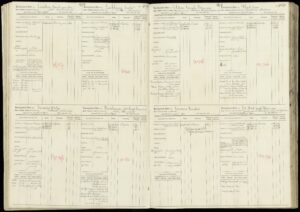
Here is an overview of the new sources, projects, and news about archives that were announced last month. Online sources The collection of Family Printed Matter of the Nederlandse Genealogische Vereniging (Netherlands Genealogical Society) is now available via Open Archives. The index contains almost 400,000 entries. Volunteers are scanning the records to be added later. Notarial records of many places in Friesland, mainly for the period 1926-1935, have been added to AlleFriezen. … [Read more...]
Dutch term – Schout
6 May 2019 by 1 Comment
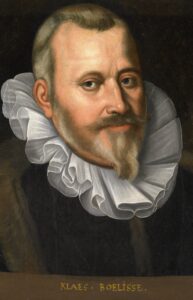
In many parts of the Netherlands, the schout used to be the term for mayor or sheriff. The schout represented the overlord and oversaw the administration and court in a district. His role combined those of a modern mayor, judge, and police commissioner. … [Read more...]
Source – Rent Registers
3 May 2019 by Leave a Comment
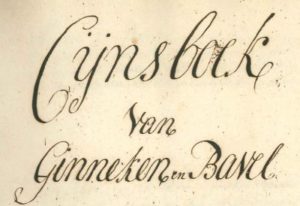
"Cijnzen" or rents are rights to annual proceeds. The rights could be attached to land or property, certain official functions, or rights in common grounds. In the Middle Ages up until say the 1700s, rents were often paid in kind, for example in grain. Dominion rents Rents could be attached to a domain, the area belonging to an overlord. For example, the overlord could give land to a family in exchange for an annual payment. These rents were perpetual. Rents could also be required to pay in … [Read more...]