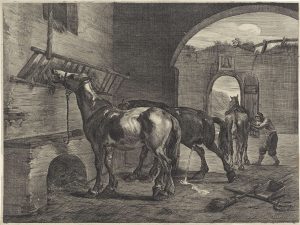
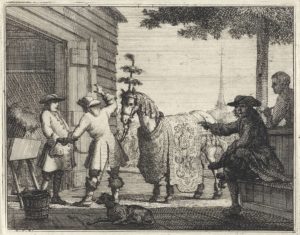
A stal is a stable. A stalhouder is a stable keeper. Originally this would have been a cattle farmer, but the meaning later changed to somebody who rents out horses and carriages. … [Read more...]
Column – Destroyed
16 December 2016 by 5 Comments
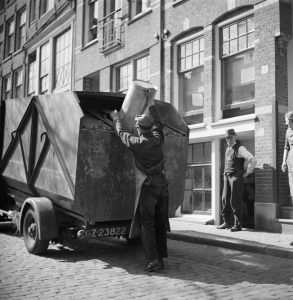
"How many of you want your work destroyed after you're gone?" This question was asked by Thomas W. Jones during a lecture. The crowd laughed; of course that was nobody's intention. Still, this will be the reality for most of us. We've invested a lot in our research; in time but also in money. Books, subscriptions, memberships, travel costs, copies or scans we ordered: most of us have spent thousands of euros/dollars. If we don't make arrangements, not much will be left in a hundred … [Read more...]
Quick tip – Create a Town Timeline
14 December 2016 by 2 Comments
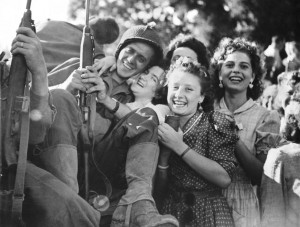
To understand your ancestors' lives better, it can help to create a town timeline showing you what was going on at the time. Here are some samples from my own research projects that show how understanding local history can help: During the Eighty Years' War, the Dutch Republic recruited regiments from all over Europe to help fight the Spanish. Some of these foreign regiments were stationed at a town where my ancestors lived. One of the Scottish mercenaries married a local … [Read more...]
Dutch term – Handelaar
12 December 2016 by 1 Comment
A handelaar was a trader. Handelaren could mostly be found in cities, not villages, and were often quite well-to-do. Sometimes, specific words were used to show what people were trading in: a graanhandelaar traded in grain, a fietsenhandelaar traded in bicycles, and a handelaar in koloniale waren traded in colonial goods. You can also use newspapers, court records, or tax records to find out what your ancestor was trading in. Another word for handelaar is koopman (merchant), where … [Read more...]
Free Alternatives to WieWasWie
9 December 2016 by 2 Comments
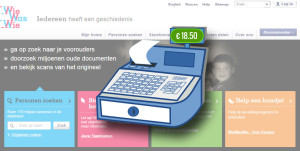
WieWasWie, the largest genealogical database in the Netherlands, introduced a paid subscription earlier this year. Here are some free alternatives. 1: Use the free version of WieWasWie You can try to make do with the free version of WieWasWie. All of the information is still available for free, but the search options are pretty limited. You can work around that by always searching for the full name. This can work if the name you search for is unusual. You can't use wildcards, but always … [Read more...]
Quick tip – What Organizations Was Your Ancestor Involved in?
7 December 2016 by Leave a Comment
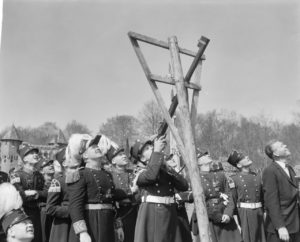
In the 1800s and 1900s, there were many organizations for every aspect of a person's life. Here are some examples I encountered in my research projects: Honorary member of the Society for the Promotion of the Musical Arts. Chairman of a local branch of the Anti-Revolutionaire Partij [Anti Revolutionary Party], a Christian political party. Deacon of the Dutch Reformed Church. Secretary of the Teacher's Association. Guardian of the Weavers' Guild. Director of the … [Read more...]
Dutch term – Pakjesavond
5 December 2016 by Leave a Comment
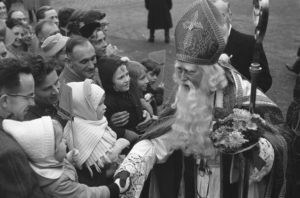
Pakjesavond = "gift evening." Traditionally, Dutch families give gifts on St. Nicholas' Eve, on December 5th. Sinterklaas and his helpers, the Zwarte Pieten, will bring gifts for all the children and some of the adults too. "Santa Claus" is derived from the Dutch word "Sinterklaas." Read more about the differences and similarities about these red-robed men in the Sinterklaas article. … [Read more...]
Celebrating Sinterklaas
2 December 2016 by 4 Comments
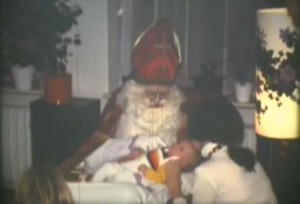
In the Netherlands, we celebrate St. Nicholas' Eve on the 5th of December. Sinterklaas arrives in the country about three weeks before, on his steam ship from Spain. He is accompanied by his helpers, the Zwarte Pieten [Black Petes] who pass out small spiced cookies called pepernoten and candy to the children. Sinterklaas then gets on his white horse and parades through town, cheered on by hundreds of young kids. My grandfather used to be Sinterklaas at the airbase where he worked and for … [Read more...]
Dutch term – Buurtschap
28 November 2016 by Leave a Comment
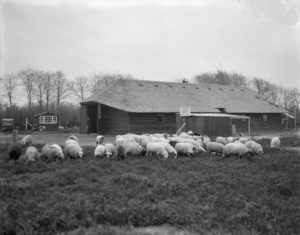
A buurtschap is literally a neighborship. It is a part of a municipality or parish. Unlike a village or town, a buurtschap usually does not have a center or church but consists of a group of farms dotting the landscape. Buurtschap is a word most commonly used in rural parts of the Netherlands. The closest English term would be hamlet. In many places, the buurtschap had an economical and a social function. Often, taxes were collected at the buurtschap level, and each buurtschap would … [Read more...]
5 Ways to Find Out When Your Ancestor Was Born
25 November 2016 by Leave a Comment
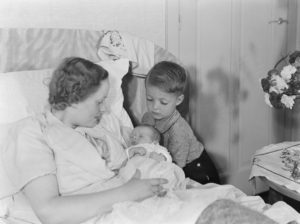
How do you find out when your ancestor from the Netherlands was born? Here are five different ways. … [Read more...]