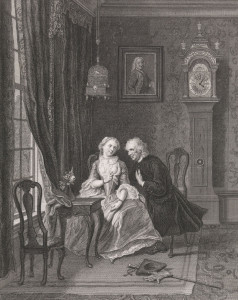
If a widow or widower with young children wanted to marry again, often they first had to make a settlement with their minor children so they received their share of the deceased parent's inheritance. These records can be helpful to prove family relationships, to get insights into the economic circumstances of the family, and to find out about subsequent marriages. These settlements can be found in orphan chamber records, voluntary court records, or notarial records, depending on the time and … [Read more...]
Dutch term – Dijkgraaf
21 November 2016 by 1 Comment
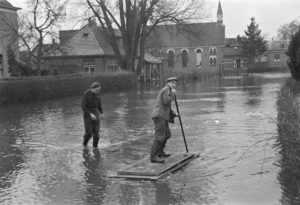
A dijkgraaf is a dike reeve, the head of a waterschap [water board]. He is responsible for the water management, including flood control, in his district. His function is similar to a mayor of a municipality. Nowadays, a dijkgraaf is appointed by the King for a period of six years. Historically, a dijkgraaf was usually somebody who had extensive property in the district for which he managed the water, to ensure he would do his best to keep the land dry. If your … [Read more...]
Ask Yvette – Where is “Friesland” anyway?
18 November 2016 by 4 Comments
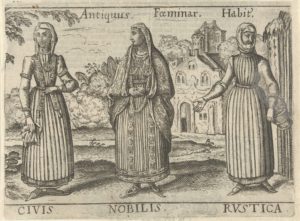
Holly (De Fries) Flaherty wanted to know more about Friesland. Her paternal grandfather was from Friesland and spoke Dutch, but her maternal grandfather was from Friesland and spoke German. She heard that there were two provinces called Friesland - one German and one Dutch. She wanted to know if they were connected, historically, and whether Denmark was once considered Friesland. To answer this question we have to go back. WAY back. Once upon a time, in the first centuries BC … [Read more...]
Quick tip – Access to restricted records
16 November 2016 by 2 Comments
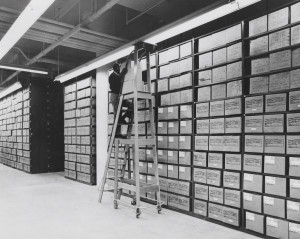
Dutch privacy laws restrict access to recent records. As a rule of thumb, access to records that may contain information about living people is restricted. For example, you can only access birth records of people born more than 100 years ago, and you can only access notarial records after 75 years. In many cases, access restrictions are set for the entire series, even when your ancestor is no longer living. Take the Central Archives of Special Jurisdiction for example, the court that … [Read more...]
Dutch term – Walvisvaart
14 November 2016 by Leave a Comment
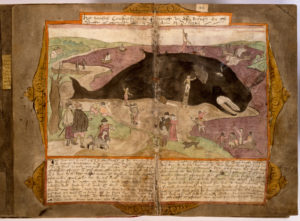
Walvisvaart is whaling. Dutch commercial whaling started in the 1600s. Many skippers from the province of Holland went north to the waters around Scandinavia and north of Russia to catch giant whales. The village of De Rijp had a thriving whaling industry and at one time had a fleet of ten whaling ships. The whale fat was turned into codfish oil, used for a wide range of purposes including lamp oil or as ingredient for soaps and paints. Whale bones were used to make glue or as building … [Read more...]
The Curious Case of Bastiana van Breugel
11 November 2016 by Leave a Comment
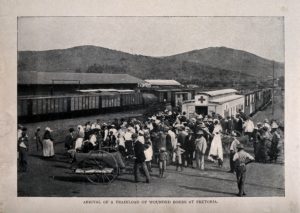
Pretoria, South Africa, 11 October 1901; the height of the Anglo-Boer War. The Dutch Consul-General in South Africa wrote to the Secretary of State in the Netherlands about a possible spy that was discovered: a Dutch nurse was suspected of slipping classified information to the Boers. The story took a strange turn when the female nurse was discovered to be a man. … [Read more...]
Quick tip – Finding out your ancestors’ political views
9 November 2016 by 1 Comment
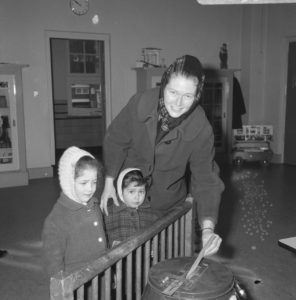
In the Netherlands, people do not have to register to vote. Our government knows where people live, and voting passes are sent to their homes. So voting records do not show party affiliations. In municipal archives, you can often find "Kiezerslijsten" that show the people who were eligible to vote. Voting itself is anonymous, so these lists will not tell you what your ancestors' political views were. Newspapers, which can be searched at Delpher, often provide the first clue that your … [Read more...]
Dutch term – Verkiezing
7 November 2016 by Leave a Comment
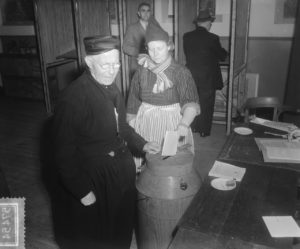
Verkiezing means election. In the Netherlands, it took until 1917 for all men to get the vote. Before that time, only men with sufficient means were allowed to cast a vote. Women followed two years later and got the vote in 1919. In the Netherlands, citizens can vote for three levels of government: National (Tweede Kamer, house of representatives) Provincial (Provinciale Staten, provincial representatives) Municipal (Gemeenteraad, the town council) Water board … [Read more...]
Benefits of Reasonably Exhaustive Research
4 November 2016 by 1 Comment
The first component of the Genealogical Proof Standard as formulated by the Board for Certification of Genealogists is Reasonably Exhaustive Research. It means trying to find "all evidence that might answer a genealogist's question about an identity, relationship, event, or situation."1 Reasonably Exhaustive Research is one of the five requirements to consider a genealogical conclusion proven. I thought it would be fun to give some examples of my own research, and the insights that reasonably … [Read more...]
Quick tip – Find More Records via the FamilySearch Catalog
2 November 2016 by Leave a Comment
FamilySearch has many records from the Netherlands, available from the Netherlands Research Page. But that page only has the large record sets. FamilySearch is digitizing the microfilms in their granite mountain vault, and those images are sometimes available from the catalog only. Example: Lichtenvoorde court records Some of my ancestors are from Lichtenvoorde in the province of Gelderland. On the FamilySearch website, I can select Search > Catalog to search the catalog by place … [Read more...]