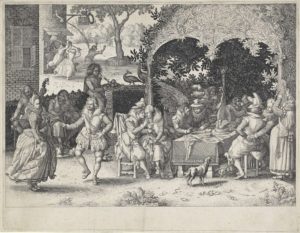
The legitieme portie (legitimate portion) is the part of the inheritance that children are legally entitled to. Under Dutch law, at least since the 1800s, children cannot be disowned by their parents completely, even if the parent makes up a will. Their legitimate portion is half of what they would have inherited if there was no will. This is different than in Anglo-Saxon law, where the testator is free to divide their estate as they see fit, including disowning their children. For … [Read more...]
Source – Census records
19 August 2016 by 2 Comments

The first nation-wide census of the Netherlands was held in 1795, during the French occupation. The first official Dutch census that recorded every individual was held in 1830 and was held every ten years. In 1850, the population register was introduced to keep the population information up-to-date in between censuses. Initially, the census was used to verify and correct the population registers. With the introduction of digital record keeping, this was no longer necessary so the decennial … [Read more...]
Dutch term – Broederdienst
15 August 2016 by Leave a Comment
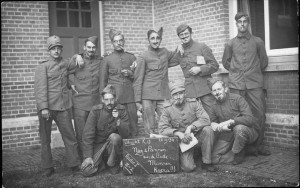
Broederdienst literally means "brother service." It was a reason for exemption of military service. If a family had an even number of sons, half of them had to serve. If they had an uneven number of sons, the lesser half had to serve. The brothers who did not have to serve got an exemption for broederdienst. You will often find these exemptions listed in the marriage supplements. … [Read more...]
Dutch term – Oogst
8 August 2016 by Leave a Comment
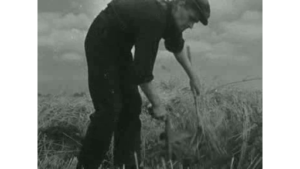
Oogst is the Dutch word for harvest. During harvest time, most schools in the countryside would be nearly empty because children were kept home from school to help with the harvest. This silent movie from 1939 shows you how traditional harvesting was done. Credits: Harvest time, by Polygoon-Profilti (producer) / Netherlands Institute for Sound and Vision (curator) (public domain) … [Read more...]
Dutch term – Abdij
1 August 2016 by 1 Comment
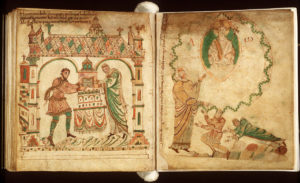
An abdij is an abbey. Especially during medieval times, abbeys were important land owners. Many of them owned large estates, farmed by tenants or serfs. In addition, they were often entitled to tithes of several properties, usually a percentage of the proceeds. The archives of these abbeys can sometimes give information about the earliest known history of the towns where they owned property, or about the tenants and serfs who worked for them. Famous abbeys in the Netherlands were located … [Read more...]
Dutch term – Hollandse Waterlinie
25 July 2016 by Leave a Comment
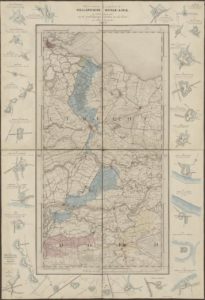
De Hollandse Waterlinie (Holland Water Defense) was a uniquely Dutch defense system that combined large-scale inundations with strategically placed forts. In times of war, large sections would be inundated to prevent an approaching army from reaching the rich cities of the province of Holland. Some smaller scale inundations had been used in the Eighty Years War (1568-1648) but in 1672, when the Netherlands was at war on three fronts, the larger scale defense line that became known as the … [Read more...]
Dutch term – Soldaat
18 July 2016 by 1 Comment
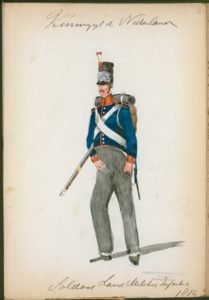
A soldaat is a soldier, the lowest rank in the army. Before the French occupation, the Netherlands only had a professional army. Soldiers were recruited from all over Europe, bringing many Scots, Swiss and other soldiers to the country. Conscription for men between the ages of 20 and 45 was introduced in 1810. It was suspended in 1997, though never officially abolished. … [Read more...]
Dutch term – Gemeentehuis
11 July 2016 by Leave a Comment
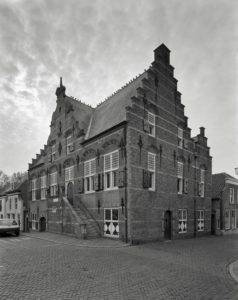
The Gemeentehuis (house of the municipality) or raadhuis (house of the council) is the town hall. In civil registration records, you will often encounter the gemeentehuis as the place where births, marriages and deaths were recorded. Civil marriages often take place at town hall. It also houses the offices of the mayor, municipal council and municipal clerks. Gemeentehuizen were originally found in the center of the town. In the 1900s, when bureaucracy increased, many places had larger town … [Read more...]
Dutch term – Plakkaat van Verlatinghe
4 July 2016 by Leave a Comment
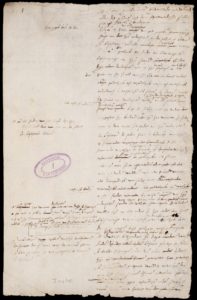
The Plakkaat van Verlatinghe was the act whereby the Estates General of the Netherlands abjured their overlord, King Philip II of Spain, on 26 July 1581. This record is considered to be the birth record of the country of the Netherlands, similar to the Declaration of Independence in the United States. The original is in Spanish hands, as it was sent to the King. A draft version on display at the Nationaal Archief, the National Archives of the Netherlands and available online. … [Read more...]
Dutch term – Boelgoed
27 June 2016 by 1 Comment
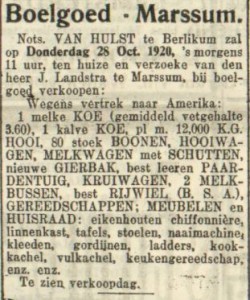
Boelgoed is an estate sale. The term is typical for the northern provinces of Friesland and Groningen. Estate sales were often organized by a notary who oversaw the public auction of movable goods. The sale was usually held at the house of the owner. You will typically find a boelgoed after somebody died, or before emigration. If the boelgoed was for the estate of a deceased, you will often find the heirs buying the majority of the items. Having a public sale was not just a way to … [Read more...]