The National Archives has a database of Dutch emigrants to Australia between 1946 and 1991. The database may only be used for historical research. The database is compiled based on the card catalogs that were created by the Dutch consulates in Sydney, Melbourne, and Brisbane between 1946 and 1991. The cards were organized by heads of household and contain information about the whole family. Only the head of household is indexed. Contents of the database The database provides basic data … [Read more...]
Dutch term – Klerk
14 October 2019 by Leave a Comment
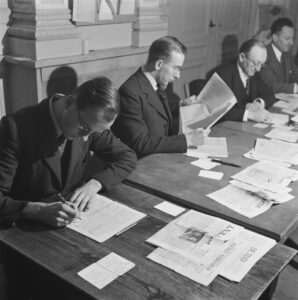
A klerk is a clerk, a civil servant. Sometimes you will see klerk ter secretarie, which means a clerk at the administrative office of the municipality. You will often find clerks acting as witnesses in civil registration records, especially birth and death records. The informant of a death or birth record needed to have personal knowledge of the birth or death, but there was no such requirement for witnesses. They were often people who happened to be at town hall, such as clerks, though in … [Read more...]
Five places to find out-of-copyright books from the Netherlands
11 October 2019 by 2 Comments
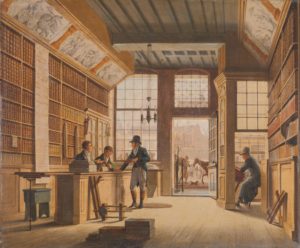
In the Netherlands, copyright expires 70 years after the author's death in most cases. Many books published in the early 1900s and earlier are in the public domain. Here are five places where you can find these publications. Delpher Delpher is a website by the Royal Library of the Netherlands where you can find books, newspapers, and magazines. Digitale Bibliotheek Nederlandse Letteren The Digitale Bibliotheek Nederlandse Letteren (Digital Library Dutch Written Works) contains many … [Read more...]
Quick tip – Use DNA to find Dutch cousins
9 October 2019 by Leave a Comment
DNA testing is becoming more popular in the Netherlands. Many Dutch people test at MyHeritage, though some also test with other companies such as Ancestry, FamilyTreeDNA, or 23andMe. To find Dutch cousins, you can take a DNA test. You will then get a list of people who tested at the same company who share DNA with you. The more DNA you share, the closer the relationship. See the article Dutch DNA testing strategy for more information to maximize your chance of finding cousins. … [Read more...]
Dutch Genealogy News for September 2019
4 October 2019 by 1 Comment
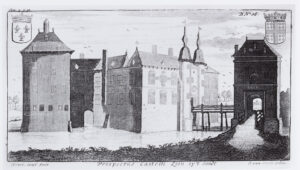
Here is an overview of the new sources, projects, and news about archives that were announced last month. Online sources The Memories van Successie (death duties files) of Noord-Brabant are being scanned and added to the Brabants Historisch Informatie Centrum website. The first batch of scans has been uploaded. Death duties files give you an overview of the property owned by people at the time of their death, tells you if they had a will, and who the heirs were. The records were already … [Read more...]
Dutch term – Vrouwenkiesrecht
28 September 2019 by Leave a Comment
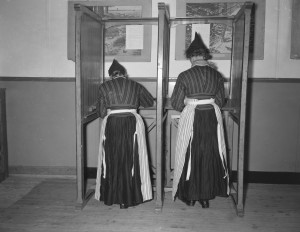
The term vrouwenkiesrecht means women's suffrage. Today it is exactly 100 years ago that women got the right to vote. The first elections were women actually got to vote was in 1920. General male suffrage was not that much older: only in 1917, men were given the right to vote without conditions on property or income. … [Read more...]
Quick tip – Don’t assume that coat of arms is yours
25 September 2019 by Leave a Comment
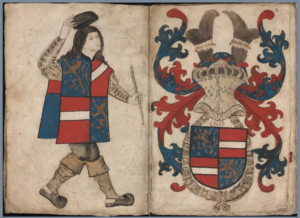
Many people mistakenly believe that finding a coat of arms with your surname means it's "your" coat of arms and that you're entitled to use it. That's not how it works. The coat of arms may have been used by a different family with the same name. You will have to trace your line back to find out if one of your ancestors ever used it. Even that doesn't mean that it's yours to use. For more information, see Ask Yvette - Does my Family have a Coat of Arms? … [Read more...]
Dutch term – Handschrift
23 September 2019 by Leave a Comment
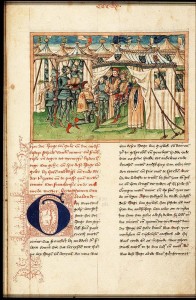
The Dutch word handschrift has two meanings: handwriting and manuscript. The further we go back, the more difficult it is to get samples of our ancestors' handwriting, or know if they even could read and write. After 1811, civil registration birth, marriage, and death records include signatures of the parties, or a statement that they couldn't write. Before 1811, notarial or voluntary court records are a good place to look for signatures. Manuscripts are records that are hand-written. They … [Read more...]
Was Eleanor of Aquitaine my Ancestor? Generation 21 – Lijsbeth van Mieren
20 September 2019 by 6 Comments
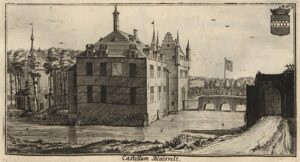
This is the twenty-second post in a series about my possible line of descent from Eleanor of Aquitaine. In the first post, I explained how I discovered the possible line, and how I am going to verify it one generation at a time. In the last post, I proved that my seventeenth great-grandfather Johan van Wijfliet was the son of Lijsbeth van Mieren. Lijsbeth van Mieren, daughter of Jan van Wijfliet Research into Jan van Wijfliet turned up two records that mentioned his father's wife: A 1349 … [Read more...]
Dutch term – Veiling
16 September 2019 by Leave a Comment
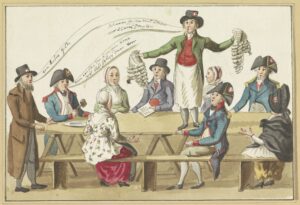
A veiling is an auction. You can sometimes find announcements of auctions in the paper, for example if a family is about to emigrate and is auctioning off their household items they won't take with them. Such an auction would be called a boelgoed in Friesland. Sometimes, notarial or voluntary court records were created to record the conditions and results of the auction. These can give you great insights into the lives of your ancestor since it shows you what items they owned. Auctions … [Read more...]