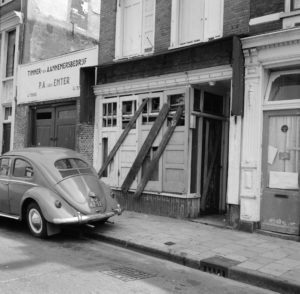
Civil registration records are generally reliable. They are created on the day itself or a few days afterward. But not all information in the record is of the same quality. In my experience, the information about the parents in a death record is the least reliable of all the information you can find in civil registration records. The informant is usually a neighbor, not a family member, who probably never knew the parents of the deceased. They may have misheard, or misremembered. They may … [Read more...]
How far did my ancestors move?
25 August 2017 by 12 Comments
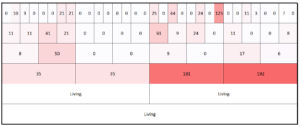
When working with American, Canadian, and Australian genealogists, I am always struck by how their family stories are about migration. The most common question is where their ancestors came from. My ancestors did not move much. Most of them married a partner from the same area, and lived their wholes lives in the same towns. I never wondered were they came from. They were just there—probably for many generations before the start of surviving records. To visualize how far my ancestors … [Read more...]
Dutch term – Beste kleed
21 August 2017 by 2 Comments
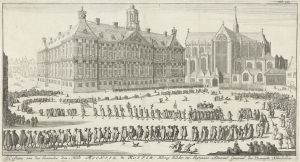
In burial records, you will sometimes see the reference to the "beste kleed" or "slechtste kleed." To someone unfamiliar with Dutch or using an automatic translator, that may look like somebody was buried in their best or worst clothes, but in fact the term refers to the lijkkleed or burial pall. The "beste kleed" was the best and most expensive pall. The "slechtste kleed" was the worst and cheapest pall. Many burial records were created as account books, to keep track of the income from … [Read more...]
Case study – Using Estate Inventories
18 August 2017 by 2 Comments
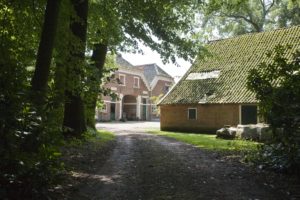
In Winterswijk, Gelderland in 1754, Jan Hendrik Hilbelink was a widower with four young children, who wanted to marry again. Before being allowed to do so, he had to come to an agreement with the guardians of his minor children. He made an estate inventory of all the possessions of him and his late wife, Aaltjen Vriesen. Their children would be entitled to her half. The inventory consists of the following items: 1 piece of farm land cooking tools (pots, baking trough, sifs) 2 … [Read more...]
Dutch term – Eiland
14 August 2017 by Leave a Comment
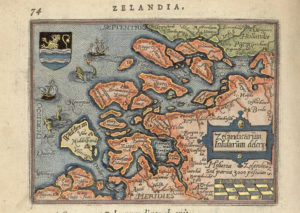
An eiland is an island. The Netherlands has several islands, such as the Zeeland islands in the south-west and the Wadden islands in the north. But there used to be many more. Large parts of the mainland of the coastal provinces used to be islands. The waterways have since been dammed off and reclaimed from the sea. Modern examples of this are the former islands of Urk and Schokland, now part of the province of Flevoland. Earlier examples include the former island of Cadzand in … [Read more...]
Quick tip – Two New Netherland Articles Published
9 August 2017 by 5 Comments
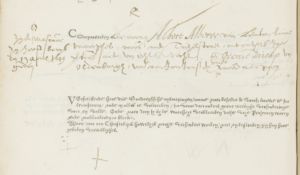
Two of my clients published articles in the New York Genealogical and Biographical Record (April 2017 issue) for which they used research I did for them: Harry Macy, "Origin of the Amerman and Terhune Families, and their Founding Mother Geertje Dirks." This article includes research I did to identify the origins of Albert Terhune, patriarch of the New Netherland Terhune family. Adrian Burke, "A Note on Origins of Alexander Glen, Alias Sander Leendertz Glen, of Schenectady County, New … [Read more...]
Dutch term – Collaterale Successie
7 August 2017 by Leave a Comment
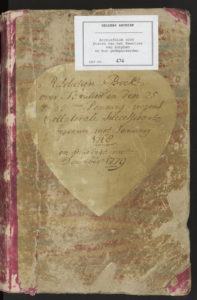
Collaterale Successie [Collateral Succession] is the situation where an inheritance goes to heirs in collateral lines, such as the siblings, aunts and uncles of the deceased, or their descendants. Many regions charged a tax on collateral successions, which was recorded in separate registers. These tax registers can give a good overview of the family composition. After about 1806, these registers were rendered obsolete by the introduction of the Memories van Successie [death duties files] … [Read more...]
Dutch Genealogy News for July 2017
4 August 2017 by 2 Comments

Here is an overview of new records and projects that were announced in the past month. Online Dutch Records Notarial records of the following municipalities in Friesland are now available via AlleFriezen, mainly for the 1920s and 1930s: St. Annaparochie, Balk, Beetsterzwaag, Bolsward, Drachten, Dronrijp, Franeker, Giekerk, Hardegarijp, Heerenveen, and Marrum. Zoekakten updated its links to FamilySearch with a range of links to scans of notarial records in Zeeland and Zuid-Holland. … [Read more...]
Quick tip – Where did the name come from?
2 August 2017 by Leave a Comment
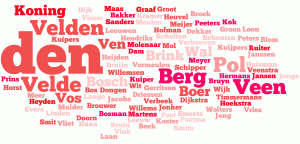
When you hit a brick wall, it might be worthwhile to look at all the names in the family. Can you account for all the names of the children? Could one of them be named after a grandparent or former spouse? Last names can provide clues about a place of origin. Different suffixes in surnames point to different regions. A matching name does not amount to prove, but it is evidence we can use to guide our research and can help to build our case. See this article about Naming patterns for … [Read more...]
Column – Unnecessary
28 July 2017 by Leave a Comment
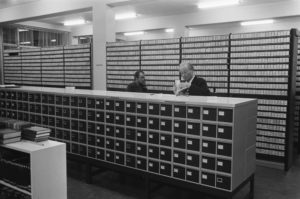
Many archival collections in the Netherlands have been cataloged in finding aids according to the principles of the nineteenth-century archivists Feith, Fruin, and Muller. Their Handleiding voor het ordenen en beschrijven van archieven [Manual for orderning and describing of archives] from 1898 states that a finding aid should merely provide an overview of the records, but should not discuss their contents. A finding aid should not make consulting the records unnecessary. A finding aid … [Read more...]