WieWasWie is the most comprehensive website with Dutch genealogical records. An English version is in the works. You can now leave your email address and get notified when the English version is available. … [Read more...]
Quick tip: Mind the dates
4 December 2013 by Leave a Comment
In the Netherlands (and most of the rest of the world), dates are routinely written as dd-mm-yyyy so 5-4-2013 means 5 April, not May 4 as it would be in the US. This can easily lead to mistakes. To avoid confusion, just use the full name of the month: 5 April 2013. That way, everybody will understand what you mean. … [Read more...]
Quick tip: find transcriptions of Achterhoek sources on Genealogiedomein
27 November 2013 by Leave a Comment
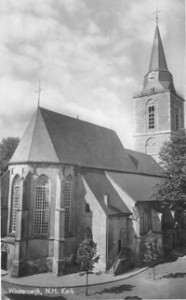
Are your ancestors originally from the eastern part of Gelderland known as the Achterhoek? The website Genealogiedomein has hundreds of (free) transcriptions in PDF-format. Most of the transcribed records are church records (baptisms, marriages and burials) from before 1811, but there is also a growing number of indexes of civil registration records (birth, marriages and deaths) after 1811. Just click the name of the municipality in the list on the left and then select the category. Some handy … [Read more...]
Quick tip: don’t expect any early photographs
20 November 2013 by Leave a Comment
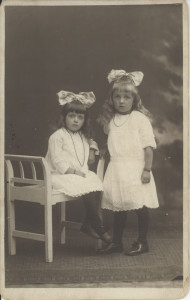
Photography took off later in the Netherlands than in the UK or the US. Most people don't have any pictures of their family that were taken before 1910/1920. If you do come across an early photograph, be very careful when dating it. A photo that looks like it would have been taken in the 1880s in the US, may well be from the 1900s in the Netherlands, since the technology was so far behind. … [Read more...]
Quick tip: Find church records at the archives, not at the churches
13 November 2013 by 3 Comments
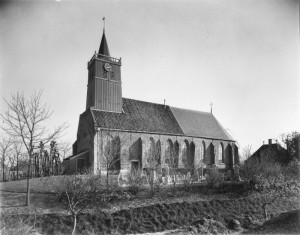
When the civil registration was introduced in 1811 or slightly earlier, the government required that all churches turn in their baptismal, marriage and burial records. These church records would become the foundation of the civil registration, where government officials could determine when a person was born, married and died. … [Read more...]
Quick tip: surnames database
6 November 2013 by 13 Comments
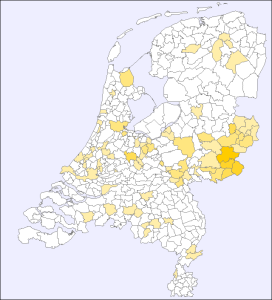
The Meertens Instituut (Institute) has a database of surnames in the Netherlands where you can search for a name to get a map that shows where people by that name lived in 1947 and 2007. This can be a great way to find out where in the Netherlands your ancestors may have come from, as many names are specific to a certain area. The example shows that the Hoitink name was most common in the eastern part of the Netherlands. This matches my genealogical research, that proved that the family … [Read more...]
Quick tip: Always check all versions of a marriage record
30 October 2013 by Leave a Comment
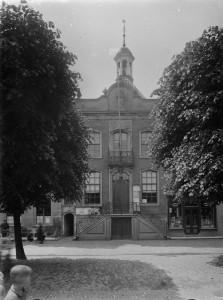
In the days before the introduction of the civil registration in 1811 (or slightly earlier in Limburg and Zeeuws-Vlaanderen), the only legally recognized marriages were those performed before the court or by the Dutch Reformed church. Roman-Catholic couples usually married in the Roman-Catholic church as well. Be sure to always check both types of records because one may include more information than the other, as the following example will illustrate. Roman-Catholic marriage record This … [Read more...]
Quick tip: know the witnesses
23 October 2013 by 2 Comments
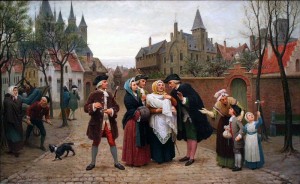
Understanding who the witnesses in records were can help you find your ancestors. Baptism witnesses were usually chosen from the immediate family, often from siblings of the parents. Witnesses or informants for death records, on the other hand, were often neighbors. Knowing these customs can help you understand who these people were and how they fit into the picture you're creating about your ancestor. … [Read more...]
Quick tip: royal dispensations
16 October 2013 by Leave a Comment
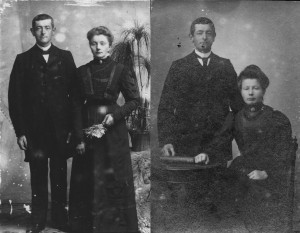
Until 1939, it was forbidden to marry your sister-in-law or brother-in-law. Royal dispensation was required for such a marriage. Many widowed men who wanted to marry their deceased wife's sister applied for a dispensation. They were routinely granted, as in the case of my great-grandparents. Extracts of the royal dispensations can be found in the marriage supplements. … [Read more...]
Quick tip: Find out what your ancestor looked like
9 October 2013 by Leave a Comment
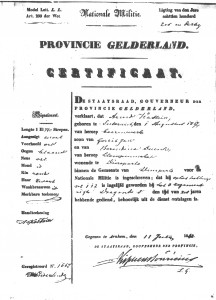
In the marriage supplements, the documents that a bride and groom had to submit when they got married, you will usually encounter a certificate stating that the groom had fulfilled his military duties. About half the time, this form will include a physical description. See elsewhere on this site for a list of terms with their translations. The example below is the certificate for Arend Kastein, showing that he was 1.74 m (5'9") tall, an oval face, ordinary stern, blue eyes, an ordinary nose and … [Read more...]