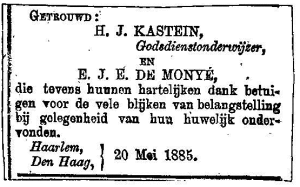
Familieberichten are family announcements, ads people placed in the newspaper to inform the readers of births, marriages or death. They are often less informative than obituaries but can help to provide background information and serve as illustrations. Read more about family announcements. … [Read more...]
Dutch term – Overspel
5 January 2015 by Leave a Comment
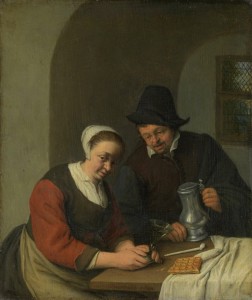
Overspel is the Dutch word for adultery. Depending on the period, adultery was not only a private matter, but could be criminally prosecuted. The church council also wanted to find out so that both parties could be censored. One of my own female ancestors was fined for insulting another woman, saying "You are keeping company with my man" and other more derogatory terms. As far as I know, the husband or the woman he was having an affair with were never prosecuted. Stories like these sure help … [Read more...]
Dutch term – Topics in an Archievenoverzicht
29 December 2014 by Leave a Comment

An archival catalog (archievenoverzicht) will give an hierarchical overview of the contents of a repository. Common topics include: Bestuur en Politiek [Government and politics] Bevolking [Population] Justitie en Rechtspraak [Justice and Court] Openbare orde en veiligheid [Public order and safety] Defensie [Defense] Notariaat [Notaries] Financiën [Finances] Verkeer en Waterstaat [Traffic and Waterways] Ruimtelijke ordening [Urban planning] Sociale zorg, welzijn … [Read more...]
Dutch term – Midwinterhoorn
22 December 2014 by 2 Comments
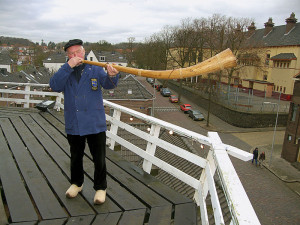
Midwinterhoorn literally means "Mid winter horn." It is a wooden horn that is typical for the eastern part of the country. The horns are made of a curved branch of a tree, which is sawed in half length-wise, hollowed out and put back together with a mouth piece attached to it. In Gelderland and Overijssel, midwinterhoorns are traditionally played during the Advent season. They are often played over a well, to amplify the sound, which can carry over miles and miles. For me, … [Read more...]
Dutch terms – begraafplaats and kerkhof
15 December 2014 by Leave a Comment
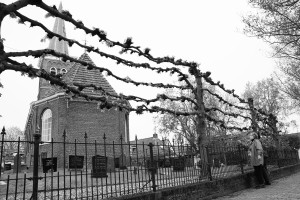
A begraafplaats or kerkhof is a cemetery. Kerkhof (literally meaning "church yard") is a cemetery around the church, while a begraafplaats (literally: "burial place") is a more generic term. In the Netherlands, graves are routinely cleared after a few decades to make room for new graves. To see what graves still exist, check online cemetery websites in the Netherlands. … [Read more...]
Source – Guardianship records
12 December 2014 by 3 Comments
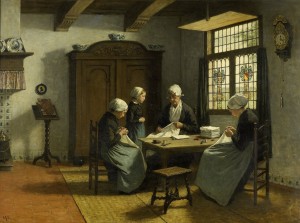
In my article about the Weeskamer (orphan chamber), an institute that oversaw the estates of orphans before 1811, several people asked me what records might exist for later orphans. The richest source of information are guardianship records, which can be found in the records of the court. Court-appointed guardians After 1811, the courts oversaw the appointing of guardians. If one parent died, the surviving parent automatically became the guardian, without the need for the court to interfere. … [Read more...]
Dutch term – Wintermaand
8 December 2014 by Leave a Comment
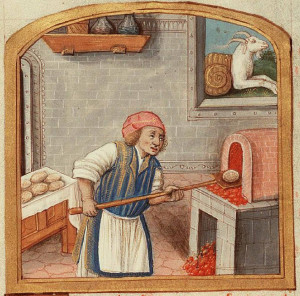
Wintermaand (literally: Winter month) is the old word for December. … [Read more...]
Case study: Lammert Huybertsen Brink
5 December 2014 by 36 Comments
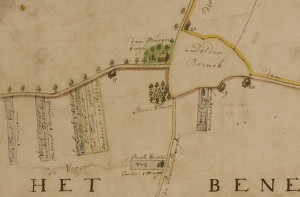
Two years ago, I helped a client, Mr. Dennis Brink, find out exactly where his family was from. He kindly agreed to let me share our story of discovery of the origins of his immigrant ancestor, Lammert Huybertsen Brink, with you. Known information When Dennis Brink first contacted me, he provided the following information about his New Netherland ancestor, Lammert Huybertsen Brink: Lammert Huyberts from Wageningen, with wife and two children ages 2 and 3 1/2 years, sailed on the … [Read more...]
Dutch term – Sinterklaas
1 December 2014 by 3 Comments
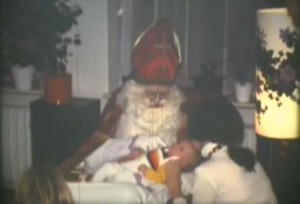
Sinterklaas is the Dutch name for Saint Nicholas. The American tradition of Santa Claus stems from the Dutch celebrating Sinterklaas. What Sinterklaas and Santa Claus have in common is their love for children and sharing gifts. But it is interesting to compare the differences in the traditions: Sinterklaas Santa Claus Feast day December 5th (St. Nicholas' Eve) December 25th Mode of transportation Arrives on a steamship. Uses a horse to get around after he … [Read more...]
Dutch term – Vroedvrouw
24 November 2014 by 3 Comments
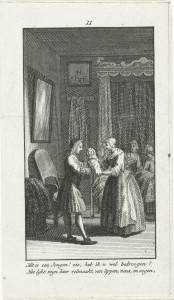
A vroedvrouw was a midwife. There were also vroedmeesters, doctors specialized in helping women deliver children. The midwife was responsible for more than just seeing the mother and the child safely through the birth. In the case of an unwed mother, she was also urged to press the mother into revealing the name of the father of her child. It was believed that no woman would lie in childbirth. She would know that she could meet her maker at any minute and would have to account for her … [Read more...]